The Best Way to Do Lateral Raises for Defined Delts
Table of Contents
+
Instructions
- Stand holding a dumbbell in each hand with your arms at your sides and your palms facing your thighs.
- Lean forward about 10–15 degrees—for most people this will put your chest a few inches in front of your toes.
- Raise your arms out to the sides and slightly in front of your torso, with a slight bend in your elbows.
- Keep raising the dumbbells until your upper arms are roughly parallel to the floor.
- Lower the dumbbells until they’re about 3–6 inches from your sides, then begin the next rep (this keeps tension on your shoulders throughout each rep).
Expert Tips
- Keep your torso as stable as possible. The more your upper body is moving during a rep, the less effective the exercise becomes for training your shoulders. If you find yourself heaving the dumbbells up, you need to use less weight.
- Think about lifting your elbows to the ceiling without shrugging your shoulders.
- Keep your palms facing the ground at the top of each rep. Avoid letting your thumb point toward the ceiling (this puts more emphasis on the front delt and less on your mid-delt).
- Don’t rest your shoulders at the bottom of each rep (with the dumbbells at your sides). Instead, immediately begin the next rep.
- Don’t lift the dumbbells above your shoulders—this doesn’t train your shoulders more effectively and reduces how much weight you can use.
Dumbbell Lateral Raise Muscles Worked
The dumbbell lateral raise primarily trains your lateral deltoids, when performed correctly.
Your shoulder muscles are composed of three parts known as the three deltoids. The anterior deltoids sit on the front of your shoulders, the lateral deltoids sit on the top and back of your shoulders, and the anterior deltoids sit on the back of your shoulders, above your shoulder blades.
Here’s how they look:
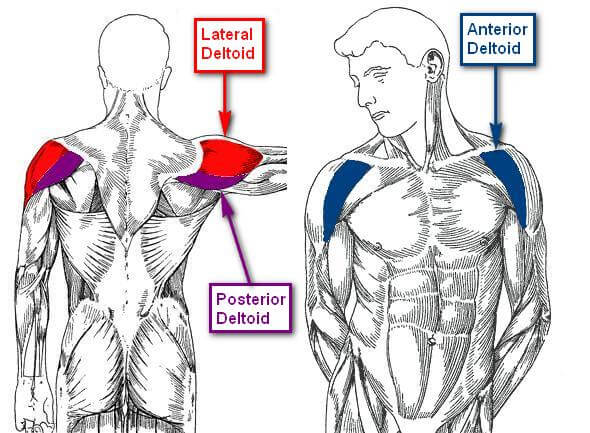
When you perform the dumbbell lateral raise the way I’ve described it above, the muscle fibers of your lateral deltoid are almost perfectly aligned with the direction the dumbbell is pulling (straight down).
The problem with how most people do dumbbell lateral raises—standing up straight, pushing the weights straight out to the sides, keeping arms as straight as possible—is that this takes some of the load off the lateral delts and puts it on the front delts.
While there’s nothing wrong with training the front delts, they usually get plenty of work from pressing exercises like the bench press, machine chest press, cable fly, and so on.
Well-developed side delts make your shoulders appear broader, which balances your upper-body aesthetics, helps create a V-taper, and is generally considered to be more physically attractive in men.
For women, they make your shoulders and upper arms look more defined and athletic. They also add shape to your upper body, which helps create an hourglass silhouette by making your waist appear narrower.
(And ladies, don’t worry—it’s basically impossible to make your shoulders look “too big” as a woman unless you’re taking steroids.)
3 Dumbbell Lateral Raise Workouts to Train Your Shoulders
Here are three sample workouts that show how.
Shoulder Workout with Lateral Raise
Barbell Overhead Press: 3 sets of 4–6 reps
Dumbbell Lateral Raise: 3 sets of 8–12 reps
Machine Reverse Fly: 3 sets of 8–12 reps
Cable Overhead Extension: 3 sets of 8–12 reps
Push Workout with Lateral Raise
Barbell Bench Press: 3 sets of 4–6 reps
Barbell Overhead Press: 3 sets of 4–6 reps
Incline Dumbbell Bench Press: 3 sets of 4–6 reps
Dumbbell Lateral Raise: 3 sets of 8–12 reps
Cable Overhead Triceps Extension: 3 sets of 8–12 reps
Upper Body Workout with Lateral Raise
Barbell Bench Press: 3 sets of 4–6 reps
Pull-up: 3 sets of 4–6 reps
Dumbbell Lateral Raise: 3 sets of 8–12 reps
Cable Overhead Triceps Extension: 3 sets of 8–12 reps
Cable EZ-Bar Curl: 3 sets of 8–12 reps
The best place for the lateral raise is in any workout that trains your shoulders or pushing muscles—a shoulder workout, push day, or upper-body day.
Within those workouts, leave it until after you’ve finished your heavy compound pressing. The side delts aren’t a main mover on exercises like the overhead press, bench press, and incline press, but they’re still involved, mostly by stabilizing your shoulders. If you tire them out with lateral raises first, you won’t be able to press as much weight, and your heavy lifting will suffer.
Save the lateral raise for after the heavy work is done, and aim for 2 to 3 sets in the 6–12 rep range.
Here are several more workouts that incorporate the lateral raise:
How to Do the 3 Best Lateral Raise Variations
1. Cable Lateral Raises
How to: Set the pulley on a cable machine to its lowest setting and attach a single handle. Stand alongside the machine with your feet together and your left foot closer to the pulley. Grab the handle with your right hand and the machine’s frame with your left.
Keeping your back straight and core tight, raise your right arm until your upper arm is parallel to the floor. Reverse the movement and return to the start. Once you’ve finished your set, switch sides and repeat with your left arm.
Why: The cable keeps tension on the side delt through the entire rep, including the stretched bottom position.
2. Lean-Away Dumbbell Lateral Raise
How to: Hold something sturdy at about chest height with your right hand—a squat rack works well—and hold a dumbbell in your left hand. Step close to the rack with your feet together. Lean away to the left until your right arm is roughly straight, then raise your left arm until your upper arm is parallel to the floor. Reverse the movement and return to the start. Once you’ve finished your set, switch sides and repeat with your right arm.
Why: Leaning away helps keep tension on your lateral deltoid throughout the full range of motion.
3. Machine Lateral Raises
How to: Grab the handles of a lateral raise machine and raise your arms out to the sides until your upper arms are parallel to the floor. Reverse the movement and return to the start.
Why: The fixed path makes it nearly impossible to cheat, and the machine keeps tension on your lateral delts throughout the entire rep.
5 Common Lateral Raise Mistakes and How to Fix Them
The dumbbell lateral raise is one of the most common exercises in the gym—and one of the most butchered.
Here are five of the biggest mistakes people make and how to fix them.
1. Raising your arms straight out to your sides
The problem: Many people do lateral raises with their arms moving directly out to their sides, like a T-pose or gymnastics cross. This trains your side delts, but not as well as it could.
The side delts sit slightly toward the back of your shoulder, not right on the side. To properly isolate the lateral delt, you need to position your body so the side delt sits on top of the shoulder joint—where it can pull your arm up against the downward pull of the dumbbell.
The fix: Learn forward about 10–15 degrees and raise your arms slightly in front of your body—about 20–30 degrees forward—into what’s called the scapular plane. This keeps the side delts directly on top of the shoulder joint where they can maximally assist with the movement.
2. Standing straight upright.
The problem: Standing with your torso perfectly vertical has the same effect as raising your arms straight out: the side delt stays slightly behind the shoulder instead of sitting on top of it, which reduces its involvement in the exercise. This forces the front delt to pitch in, stealing work from the side delt.
The fix: Lean forward slightly—about 10–15 degrees—throughout the set.
3. Lifting too much weight.
The problem: The side delt is a tiny section of a small muscle, and the mechanics of the lateral raise put it in a tough spot. You’re holding the weight in your hand, which is far away from your shoulder, so the muscle has to work against a long lever. And that’s why you simply can’t lift heavy weights on this exercise.
Once the weight gets too heavy, your body finds ways to make it easier—you start shrugging, swinging your torso, or doing a little dip-and-heave at the start of each rep. The more you use momentum and other muscle groups to swing the dumbbells upward, the less effective the exercise is for your lateral delts.
The fix: Use weights you can lift for between 6 and 12 reps with strict form. If you need to swing, shrug, or heave to get the dumbbells up, decrease the weight.
4. Lifting the dumbbells too high.
The problem: You’ve probably seen people doing a version of the dumbbell lateral raise where they lift the dumbbells until their arms are pointing straight up at the ceiling. The logic goes like this: more range of motion = the shoulders do more work = more muscle growth.
The reality, though, is that once you raise your arms above your shoulders, your rotator cuff muscles and traps start doing more of the work, and your bones are actually supporting much of the weight when holding it directly overhead.
In other words, there’s no muscle-building benefit to lifting dumbbells higher than your shoulder. In fact, they’re maximally stimulated when the dumbbells are at about chest height.
Research also shows that raising your arms above parallel—so your upper arms go higher than your shoulders—can put the shoulder joint in a precarious position and increase the risk of impingement, a common cause of shoulder pain. This is especially true if you perform dumbbell lateral raises the way most people do, with their arms straight out to the sides.
The fix: Stop each rep when your hands are somewhere between chest and shoulder height (whatever is most comfortable for you).
5. Turning your thumb downward.
The problem: A common cue is to rotate your wrists at the top of each rep so your thumbs point slightly toward the floor, as if you’re pouring water out of a jug. This cue was borrowed from physiotherapy, where therapists use it to help people recover from shoulder injuries while lifting very light weights.
While this technique can increase side delt activity, I’m not a fan of it for several reasons:
- It’s not necessary if you do dumbbell lateral raises the way I’ve explained this article—twisting your thumbs doesn’t further stimulate your lateral delts.
- It’s uncomfortable for most people and may increase the risk of shoulder impingement.
- It typically reduces how much weight you can lift, and less weight = less tension on the muscle which generally means less muscle growth over time.
The fix: Keep your thumbs pointing forward and the back of palms facing the floor throughout each rep.
Dumbbell vs. Cable vs. Machine Lateral Raises
Many people “spam” lateral raises without much to show for it (perhaps we should call this “shouldermaxxing?”).
Usually it’s because they’re making one of the mistakes above—especially using too much weight, standing too upright, or raising their arms directly out to the side.
All these problems prevent the side delts from working hard enough to grow, and that’s why fixing them is often enough to turn things around.
But even a perfectly performed dumbbell lateral raise has one weakness: its resistance curve.
At the bottom of the rep, when your arms hang at your sides, your side delts are at their most stretched—but there’s almost no tension on them. The higher you raise your arms, the harder it gets, so the most tension lands at the top of the rep, when the side delts are shortest.
That’s a problem, because research shows muscles grow best when they’re challenged in a stretched position rather than a shortened position. So the lateral raise puts less tension on the side delts exactly where it would help most.
And regardless of whether a muscle is stretched or shortened, less tension generally just means less muscle growth. Thus, if the bottom ~⅓ of every rep of dumbbell side raises doesn’t put much tension on the lateral delts, that represents a missed opportunity for growth.
The best is the cable lateral raise. Cables keep tension on the lateral delt throughout the full range of motion, which is probably better for muscle growth.
Now, one study found no difference in muscle growth between the cable and dumbbell lateral raise, which would seem to contradict what I just wrote. This study only lasted 8 weeks, though, which is simply not enough time for small differences like this to become statistically significant, much less visible.
Compare these two exercises over 12 months, and I’d bet you’d see marginally more growth with cable side raises. That said, the differences would be small, and most people get bored with doing one variation of an exercise like this for a whole year without mixing it up, so this largely becomes a moot point. But if I had to pick between dumbbell lateral raises and cable lateral raises, I’d pick the latter for this reason.
Machines offer similar benefits to cables, but many gyms either don’t have lateral raise machines or have subpar ones that make it hard to get into a biomechanically optimal position, which is why they aren’t my default choice.
You can also lean away from the dumbbell and rest your opposite arm on a bench or squat rack. This puts more tension on your lateral delts at the beginning of each rep, but still not as much as you’d get if you just used a cable or machine.
Again, none of this is worth losing sleep over—I’ve worked with tens of thousands of people over the past 20 years, and I’ve seen people build incredible shoulders doing mostly dumbbell lateral raises, mostly cable lateral raises, and a mix of both. The most important thing is that you use proper technique, push each set close to failure, and are consistent over time.
But … if you’ve been grinding away at dumbbell lateral raises and want to try something new, give the cable or machine lateral raise a shot.
Want More Content Like This?
Check out these articles:
- The Best Dumbbell Shoulder Exercises & Workouts for Mass
- Best Front Deltoid Exercises for Mass
- The 10 Best Rear Delt Exercises for Strong, Balanced Shoulders
The post The Best Way to Do Lateral Raises for Defined Delts appeared first on Legion Athletics.
https://ift.tt/ZfQqIrV June 8, 2026 at 06:00PM Legion Athletics


Comments
Post a Comment