Cycle Syncing Workouts & Diet: What Science Really Says

Cycle syncing has become one of the loudest trends in women’s fitness.
You’re told that if you don’t train and eat differently in each phase of your menstrual cycle, you’re fighting your biology—and leaving results on the table. Lift heavy here. Back off there. Eat more now. Eat less later.
It sounds scientific. It sounds empowering. And it sounds like something you should be doing—especially if your goal is a specific look, like an hourglass body.
But when you strip away the charts, apps, and influencer advice and look at the actual evidence, the story changes. The menstrual cycle doesn’t work like a perfect calendar—and it doesn’t demand a constantly changing workout or diet.
In this guide, you’ll learn what cycle syncing gets wrong, what the science actually says, and what to do instead if you want better results without overcomplicating your training.
Key Takeaways
- Cycle syncing claims you need to change your workouts and diet based on menstrual cycle phases to get better results.
- The menstrual cycle isn’t predictable enough for that approach to work well, and hormones don’t stay steady within neat “phases.”
- Research shows most women can train effectively throughout the month, with no meaningful differences in strength or muscle growth between cycle phases.
- The smartest training approach is consistency, with small, reactive adjustments only when symptoms actually interfere.
- Diet doesn’t need to be “phase synced” either—appetite often rises in the luteal phase, and planning for that works better than following a cycle-based diet.
- What Is Cycle Syncing Your Workouts?
- The Problems with Cycle Syncing Workouts
- What Science Says About Cycle Syncing Workouts
- What to Do Instead of Cycle Syncing
- What About Cycle Syncing Your Diet?
- The Bottom Line on Cycle Syncing Workouts and Diet
- FAQ #1: What is the best exercise during the menstrual cycle?
- FAQ #2: Can cycle syncing workouts work if you’re on hormonal birth control?
- FAQ #3: How does my menstrual cycle affect my workout?
- FAQ #4: Is it good to work out on your period?
- Want More Content Like This?
Table of Contents
+What Is Cycle Syncing Your Workouts?

“Cycle syncing workouts” are workouts you plan around your menstrual cycle.
The idea is that you change the type or intensity of training you do based on where you are in the cycle—pushing harder when hormones are thought to support performance, and backing off when they’re thought to work against it.
In practice, most cycle-syncing plans have you make pre-planned changes to your workout routine based on where you think you are in your cycle.
For example, you might spend two weeks lifting heavy weights, switch to mostly cardio the following week, then spend another week doing very light exercise, yoga, or stretching—then repeat.
The Problems with Cycle Syncing Workouts
Cycle syncing exercise advice usually treats your cycle like a perfect calendar: four clean phases, each with a clear hormone “profile,” and a workout plan to match.
Real life doesn’t work that way.
First, hormone levels don’t stay steady within a phase. Most cycle-syncing charts make it look like the follicular phase has one stable hormone profile and the luteal phase has another, like this:
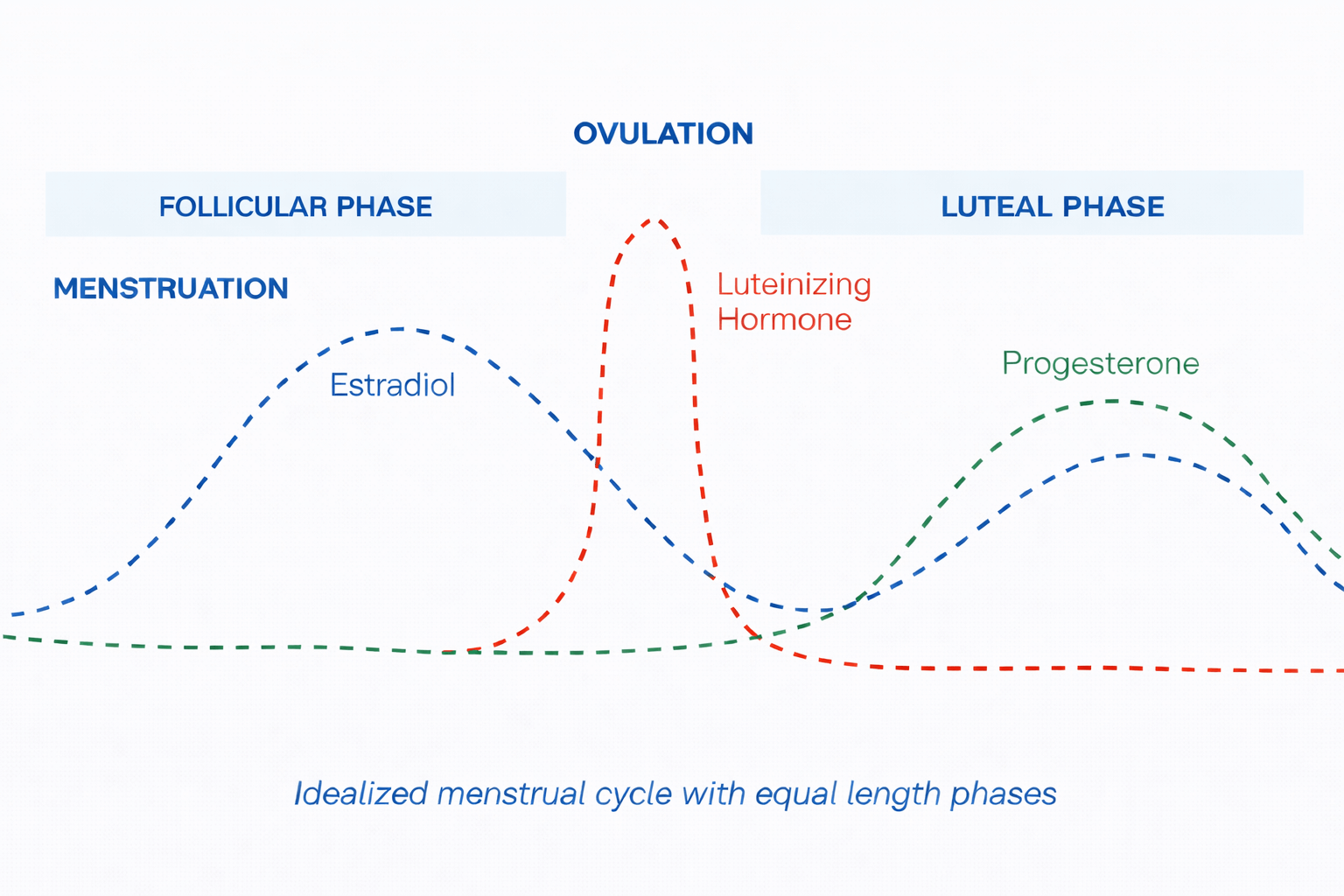
But hormone levels rise, peak, and fall throughout the cycle—so even if you label your phase correctly, the “profile” you think you’re training for may not be what’s happening that week.
Second, the timing isn’t as predictable as the charts assume. A lot of plans assume a 28-day cycle and ovulation right in the middle. Research shows the reality is quite different: cycle length and ovulation timing vary a lot between women—and can shift from month to month for the same woman.
That’s a problem for plans built around “two weeks of this, then two weeks of that.”
Third, apps track your cycle—not your hormones. They can help you estimate when your period might start, but they don’t reliably tell you when you ovulate unless you add extra data—and they can’t tell you whether your cycle followed the hormone pattern the chart assumes.
So when someone uses an app to decide, “This is my follicular week, so I should push hard,” they’re often guessing more than they realize.
What Science Says About Cycle Syncing Workouts
Cycle syncing sounds logical on paper: hormones change throughout the month, so it seems reasonable to ask whether there are times when training feels easier—or harder—and whether that affects results.
The question is whether those hormonal changes create clear, reliable windows where performance improves or muscle growth accelerates—and whether those patterns are consistent enough to plan training around.
That’s what the research tries to answer.
Does Performance Change Across Menstrual Cycle Phases?
If cycle syncing is going to work the way it’s marketed, we’d expect a clear, consistent pattern—like noticeably better strength and performance in one phase and noticeably worse in another.
But that’s not what the evidence shows.
When researchers compare performance across cycle phases, the overall picture is that performance doesn’t meaningfully change from phase to phase, and any differences that do show up tend to be trivial.
And for that reason, your best default is to assume you can train well throughout the month. If you feel great, push as planned. If you feel lousy, adjust. But don’t assume a phase label automatically tells you how you’ll perform.
Does Cycle Phase Affect Muscle Growth or Strength Gains?
This is the real promise of cycle syncing: not just that you might feel better in the gym, but you’ll build more muscle or gain more strength if you align training to the “right” phases.
The evidence for that is weak, though.
For one, the core processes that drive muscle growth don’t seem to flip on and off depending on where you are in your cycle. For instance, studies looking at muscle protein synthesis rates and strength gain generally show no meaningful differences across phases.
You’ll sometimes see cycle-syncing supporters point to studies suggesting follicular-phase-focused training produced better gains than luteal-phase workouts.
But those findings come with major limitations, and they’re not strong enough to justify rewriting your program around them—especially when cycle timing and hormone patterns vary so much from person to person, and consistency is usually the main driver of results.
So, for most, the “boring” approach to training is still the right one. Pick an effective training split, follow it consistently, progress over time, and adjust only when symptoms are severe enough to interfere with training.
What to Do Instead of Cycle Syncing
Instead of pre-planning your training around a phase chart, use a much simpler approach: train consistently, and adjust only when you actually need to.
That means keeping the same program in place month to month, and making small, short-term changes when symptoms are real enough to interfere with training.
In practice, that usually looks like this:
- If you feel good, train as planned.
- If symptoms are mild, reduce your workload and effort. Do 1 or 2 fewer sets per exercise and train further from failure than usual (for example, leave 3–4 reps in reserve instead of 1–2).
- If symptoms are severe (heavy cramps, GI distress, headaches, or migraines), treat it like you’re sick—skip your workout and return to training when you feel better.
The key point is that these adjustments are reactive, not pre-planned. You’re responding to how you actually feel and perform, not what a calendar or app says should be happening.
For most people, that means adjusting one or two workouts per month, not rewriting your entire program. This approach keeps the things that matter most for results—consistency, progression, and adherence—intact, while still giving you flexibility when your body needs it.
What About Cycle Syncing Your Diet?
Cycle syncing your diet is the same basic idea as cycle syncing your workouts: you change what (or how much) you eat at different points in your cycle based on how hormones are supposed to affect things like calorie burn, hunger, and cravings.
Eating according to your menstrual cycle is also claimed to increase energy, relieve symptoms of PMS, and help balance your hormones. It’s also sometimes tied to claims about changing fat storage patterns—especially in areas like the lower belly (FUPA) or hips and thighs.
Like a menstrual cycle workout plan, research doesn’t strongly support cycle syncing your diet.
The biggest, most consistent cycle-related change is appetite. On average, women eat more and crave sweet foods more in the luteal phase—the week or two after ovulation—than in the follicular phase.
Evidence also suggests your metabolic rate is slightly higher in the luteal phase, but the increase tends to be modest—so it’s not a “free pass” that reliably cancels out stronger cravings.
So rather than trying to cycle sync your diet, a better plan is to eat mostly nutritious, minimally processed foods every day of the month, and make small adjustments during the part of the month most likely to trip you up—the luteal phase.
That might mean . . .
- Leaning harder on high-satiety foods (more protein, fruit, vegetables, potatoes, legumes, and other high-fiber staples) so hunger is easier to manage.
- “Budgeting” for sweets by planning them into your day instead of trying to white-knuckle cravings and then overeating later.
- Using higher-calorie days strategically (a small, planned bump in calories when hunger is highest) as long as you balance it out over the week.
- Keeping trigger foods out of “easy reach” and making the easy choice the good choice (prepped meals, protein on hand, planned snacks).
The goal isn’t to chase a perfect “phase diet.” It’s to stay consistent when your appetite is working against you—and make it easier to stick to your plan without feeling miserable.
The Bottom Line on Cycle Syncing Workouts and Diet
Cycle syncing sounds appealing because it offers clear rules and “phases” to follow. But in practice, the menstrual cycle isn’t predictable enough—and performance, muscle growth, and calorie needs don’t change in clean, reliable windows.
Research shows you can generally train well throughout the month, and while appetite often rises in the luteal phase, that’s best handled with planning—not a completely different diet.
The most effective approach is simple: train consistently, adjust only when symptoms actually interfere, eat a nutritious diet year-round, and plan ahead for the times hunger and cravings are higher.
FAQ #1: What is the best exercise during the menstrual cycle?
There isn’t one “best” exercise for a specific phase of the menstrual cycle. Research shows that most women can train effectively throughout the month, and strength and performance don’t change in large, predictable ways from phase to phase.
FAQ #2: Can cycle syncing workouts work if you’re on hormonal birth control?
Cycle syncing workouts generally don’t make much sense if you’re on hormonal birth control. Many forms of hormonal contraception suppress the natural fluctuations in estrogen and progesterone that cycle syncing is based on.
Although you may still experience some menstrual symptoms, it isn’t the same as a natural menstrual cycle with predictable hormone changes. That means the “phases” cycle syncing relies on often aren’t there in the way charts assume.
FAQ #3: How does my menstrual cycle affect my workout?
For most women, the menstrual cycle affects how training feels more than how well they can perform. Research suggests that strength and performance don’t meaningfully change across cycle phases, but symptoms can.
Things like cramps, headaches, poor sleep, bloating, or low energy—often around the start or end of the cycle—can make workouts feel harder. When that happens, adjusting your training makes sense. On symptom-free days, you can usually train normally.
In other words, your cycle doesn’t dictate what you can do in the gym, but it can influence when you might want to ease off slightly or push harder.
FAQ #4: Is it good to work out on your period?
For most women, yes—it’s perfectly fine to work out on your period. Research shows that being on your period doesn’t automatically reduce strength or performance, and many women can train normally if they feel up to it.
That said, symptoms matter more than the calendar. If cramps, fatigue, headaches, or heavy bleeding make training uncomfortable, it’s smart to dial things back or take a rest day.
The best approach is simple: if you feel okay, train as planned; if you don’t, adjust or rest without guilt.
Want More Content Like This?
Check out these articles:
- How to Get Rid of Armpit Fat & Bra Bulge Fast
- How to Fix “Mom Butt” After Pregnancy
- Hip Dips: What They Are and What to Do About Them
The post Cycle Syncing Workouts & Diet: What Science Really Says appeared first on Legion Athletics.
https://ift.tt/sABKwZg January 01, 2026 at 07:00PM Legion Athletics


Comments
Post a Comment