What Is Ozempic Butt? Causes, Prevention, and How to Fix It
Walking is the most underprescribed medicine for improving your metabolism, mood, and mind. If it were a pill, it’d outsell Ozempic.
Until that day comes, however, Ozempic will continue to be one of the most popular—and effective—tools for rapid weight loss.
But rapid weight loss comes with trade-offs. And one of the most talked-about lately is something the internet has dubbed “Ozempic butt.”
If you’ve heard the term, you’ve probably seen it framed as a cosmetic issue—a strange side effect of the drug that makes your butt look flatter or saggy. What’s rarely explained is why it happens, what’s actually changing in your body, and what you can realistically do about it.
This article breaks all of that down—what Ozempic butt is, why it happens, and how to prevent or fix it without resorting to cosmetic quick fixes that miss the real problem.
Key Takeaways
- “Ozempic butt” refers to a butt that looks flatter and saggy or crepey after rapid weight loss.
- It’s not a direct side effect of Ozempic—it happens when you lose fat, muscle, and skin elasticity at the same time.
- Cosmetic procedures may change how your butt looks, but they don’t restore your muscle, strength, or long-term function.
- The most effective way to prevent or fix Ozempic butt is to rebuild lost glute muscle by lifting weights and eating enough protein.
- If hitting your protein target is tough, options like Whey+, Casein+, Plant+, or Legion’s protein bars, cookies, or crispy treats can make it easier.
- What Is “Ozempic Butt”?
- What Does Ozempic Butt Look Like?
- Why Ozempic Butt Happens
- Why The Main Solution Is Rebuilding Muscle
- How to Prevent Ozempic Butt While Losing Weight
- Ozempic Butt and Face: Why They Often Show Up Together
- The Bottom Line on Ozempic Butt
- FAQ #1: Is Ozempic butt a real side effect of Ozempic?
- FAQ #2: Can Ozempic butt be reversed naturally?
- FAQ #3: How long does Ozempic butt last?
- Want More Content Like This?
Table of Contents
+What Is “Ozempic Butt”?
“Ozempic butt” is the internet’s name for a deflated, flatter-looking butt that sometimes shows up when people lose a lot of weight quickly—often while taking GLP-1 drugs like Ozempic.
It’s not that the drug “targets” your butt. It’s that when you lose weight, you don’t just lose fat. You also tend to lose some fat-free mass (which includes muscle), and your skin doesn’t always snap back as fast as the scale drops.
When all three happen together—less fat, less muscle, looser skin—the result can look like your glutes shrank and flattened fast.
What Does Ozempic Butt Look Like?
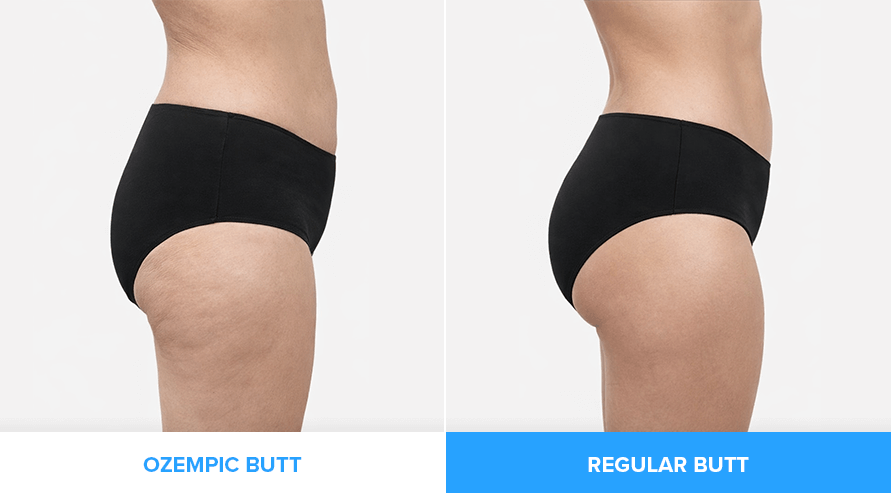
Most people use “Ozempic butt” to describe a butt that has . . .
- Less fullness and roundness (especially in the upper and outer glutes)
- A flatter shape overall (more “pancaked” than “pert”)
- More looseness or sagging because the skin isn’t as supported by fat and muscle
- A “wrinkly” or “crepey” look
In other words, it’s not just that the butt gets smaller—it can look smaller and less firm at the same time, which makes the change more noticeable.
(Some women notice a similar effect after giving birth.)
Here’s how Ozempic butt typically looks:
Why Ozempic Butt Happens
Ozempic butt isn’t caused by one thing. It usually comes from a combo of less fat, less muscle, and looser skin—all happening at the same time.
Fat Loss
Almost everyone stores a significant amount of body fat around their glutes (butt muscles). When you lose body fat, your glutes naturally lose some of their “padding.” If you were carrying a decent amount of fat there, the change can be dramatic.
Muscle Loss
When you lose weight, you don’t only lose fat—you also tend to lose some muscle.
This happens because your body has to make up for the energy you’re no longer eating by pulling energy from stored tissue—mostly fat, but sometimes muscle too (especially when weight loss is fast or calorie intake is very low).
In addition, eating fewer calories than you burn shifts your body toward breaking down muscle more easily and building it less efficiently.
That matters because your glutes get a lot of their shape from muscle. So if you lose muscle there, your butt can look smaller, flatter, and less “lifted,” even if you’re happy with the number on the scale.
Skin Elasticity
Even if you preserve every ounce of muscle while dieting (you won’t), skin still has to adapt to a smaller body.
When weight comes off quickly, skin often lags behind. That can create looseness and “crepey” texture, especially in areas where there was more fat before.
This is one reason Ozempic booty can look worse than you’d expect from fat loss alone: the loss of volume reveals skin laxity.
Why The Main Solution Is Rebuilding Muscle
Most people think of Ozempic butt as a cosmetic problem—something unfortunate to look at, but not much more than that.
That’s a mistake.
Ozempic butt isn’t just about appearance. It creates a couple of real issues that go well beyond a flatter, saggier butt.
First, losing glute muscle affects how your body functions. Your glutes aren’t decorative muscles. They help you stand up from chairs, climb stairs, stabilize your hips and spine, and move efficiently when you walk, run, jump, or change direction.
When those muscles shrink, those movements get harder. Over time, lower-body strength and stability decline, which can affect everything from athletic performance to basic daily activities.
Second, it can affect your long-term health. The glutes are large muscles, and muscle tissue plays an important role in metabolic health and healthy aging. Losing muscle doesn’t just change how you look today—it can influence how strong, capable, and resilient you are years down the line.
Most popular resources about how to “fix” Ozempic butt miss these points entirely. In fact, many of the top search results for terms like “Ozempic butt” come from cosmetic surgery clinics that frame it as a purely aesthetic issue—something they can fix with lifts, tucks, and fillers.
Those procedures may change how your butt looks, but they don’t fix the underlying problem. That is, they don’t restore muscle, strength, or function.
That’s why cosmetic fixes are a poor long-term solution. They may improve appearance for now, but they do nothing to improve your health—and nothing to address the real cause of Ozempic butt in the first place.
How to Prevent Ozempic Butt While Losing Weight
If Ozempic butt is caused by losing muscle during rapid weight loss, then prevention comes down to one thing: reduce how much muscle you lose while the weight comes off.
You can’t fully prevent muscle loss while dieting—especially when weight loss is fast—but you can meaningfully limit it. And you do that by focusing on two levers: protein intake and strength training.
Protein
The protein you eat is your body’s main source of amino acids, which are the building blocks of muscle tissue.
Your muscles are always breaking down and rebuilding. When you eat enough protein, your body has the amino acids it needs to rebuild muscle. When you don’t, more muscle gets broken down than rebuilt over time.
That’s why studies show that people who eat more protein while losing weight—including those taking GLP-1s—tend to keep more muscle than those who don’t.
To prevent muscle loss while using Ozempic (and while also strength training), aim for 1 gram of protein per pound of body weight per day.
And if you find eating enough protein tough, options like Whey+, Casein+, Plant+, or Legion’s protein bars, cookies, or crispy treats can make it easier.
Strength Training
When you lift weights, you send a signal to your body that the muscle is still needed. That signal becomes especially important during weight loss, when your body is deciding what tissue it can afford to keep.
Studies show that adding exercise—especially strength training—to a calorie-restricted diet shifts more of the weight loss toward fat and less toward fat-free mass. In other words, people who lift weights tend to keep more muscle while losing weight than those who don’t.
This is why strength training is non-negotiable if you’re trying to avoid or reverse Ozempic butt. Without it, your glutes have no reason to stay the same size, and muscle loss becomes much more likely.
Which Exercises Work Best?
The most effective glute exercises all have one thing in common: they train the glutes through a full range of motion and allow you to use progressively heavier weights over time.
Examples include:
- Back squat
- Bulgarian split squat
- Goblet squat
- Deadlift
- Romanian deadlift
- Hip thirst
- Glute bridge
- Lunge
- Reverse lunge
- Step-up
If you want a complete program that includes these exercises and also build balanced, full-body muscle, check out this routine:
The Ultimate Workout Routine for Women
Ozempic Butt and Face: Why They Often Show Up Together
“Ozempic butt” and “Ozempic face” are really the same issue showing up in two different places.
In both cases, rapid weight loss reduces fat, muscle, and skin elasticity at the same time.
The face shows it quickly because it has relatively little muscle and fat to begin with. When volume drops fast, the skin can look looser, more hollow, or more aged.
The butt shows it because its shape depends heavily on muscle mass, especially the glutes. When that muscle shrinks, the area can look flatter and less lifted.
So it’s not that Ozempic targets the face or the butt specifically. It’s that rapid weight loss changes the tissues that give certain areas their shape, and some areas are simply more sensitive to those changes.
The Bottom Line on Ozempic Butt
Ozempic butt isn’t really about Ozempic—and it’s not just cosmetic.
It can happen when rapid weight loss leads to fat loss, muscle loss, and looser skin at the same time, especially in an area where shape and function depend on muscle.
Cosmetic fixes may change appearance, but they don’t solve the real problem. The best way to prevent or fix Ozempic butt is to protect and rebuild muscle by eating enough protein and lifting weights consistently.
Do that, and you don’t just improve how your butt looks—you support long-term strength, function, and health.
FAQ #1: Is Ozempic butt a real side effect of Ozempic?
Not exactly. Ozempic doesn’t directly cause changes to your butt. What people call “Ozempic butt” is a result of rapid weight loss, which often includes fat loss, muscle loss, and looser skin. Those changes can be more noticeable when weight comes off quickly, especially if muscle isn’t preserved during the process.
FAQ #2: Can Ozempic butt be reversed naturally?
In most cases, yes. Strength training and eating enough protein can help restore glute muscle over time, improving both your butt’s shape and lower-body function. Results take consistency and patience, but muscle is highly adaptable—even after weight loss.
FAQ #3: How long does Ozempic butt last?
How long Ozempic butt lasts depends on how much muscle you lost and what you do next. If you don’t take steps to rebuild muscle, the changes can stick around indefinitely.
But if you lift weights consistently and eat enough protein, most people see steady improvement within 3–6 months as they rebuild lost muscle.
Want More Content Like This?
Check out these articles:
- How to Get Rid of Saddlebags: The Only Approach That Works
- Hip Dips: What They Are and What to Do About Them
- How to Get Rid of Bat Wings: Exercise & Diet That Works
The post What Is Ozempic Butt? Causes, Prevention, and How to Fix It appeared first on Legion Athletics.
https://ift.tt/AiQc12H February 12, 2026 at 07:00PM Legion Athletics


Comments
Post a Comment