The Best Way to Do the Barbell Romanian Deadlift
- Instructions
- Expert Tips
- Mike's Take
- Muscles Worked by the Romanian Deadlift
- 3 Romanian Deadlift Workouts
- Romanian Deadlift vs. Deadlift vs. Stiff-Leg Deadlift
- More Hamstring and Glute Exercises
Table of Contents
+Instructions
- Adjust the pins or hooks in a squat rack so the bar is at your midthigh, and load it with plates (or load the bar on the floor if you don’t have a rack).
- Grip the bar just outside your thighs with your palms facing you, lift it off the rack (or floor), take one step back with each foot, and turn your toes out and bend your knees slightly.
- Stand up tall with your chest out and arms at your sides, take a deep breath into your stomach, and brace your abs.
- Squeeze the bar as hard as you can, press your upper arms into your sides, and, with a flat back, lower the bar toward the floor in a straight line, allowing your butt to move backward as the bar descends.
- Once you feel a stretch in your hamstrings, bend your knees just enough to let the bar keep descending, and continue lowering it until your lower back begins to round—just below the knees for most people, about midshin for the particularly flexible.
- Bring the bar upward by driving your hips toward it, keeping your arms straight, lower back slightly arched, and core tight, and return to the starting position.
- On the last rep of a set, finish it fully (legs locked), then move the bar back to the pins or hooks—don’t try to deadlift it directly back onto them.
Expert Tips
- A good cue to keep your back straight and your upper body stable is to imagine “crushing oranges in your armpits.”
- Lower the bar until you feel a deep stretch in your hamstrings and your lower back is about to round—usually just below the knees, about midshin if you’re especially flexible—then stand back up. This trains your hamstrings hard in a lengthened, stretched position, and research shows that this is generally advantageous for muscle growth. Trying to go lower than this increases your risk of injury and takes tension off the muscles you’re trying to train.
- If you’ve never done a Romanian deadlift (or any kind of deadlift) before, bending over from the waist like this with a flat back can feel awkward. A good way to get the hang of it is to practice the first half of the rep—keep your back straight, your legs completely straight, and your butt high, and bend over at the waist as deep as you can without lowering your hips or bending your knees. Imagine you’re bowing to someone like a butler. Once this feels comfortable, do it again, but once you reach the limit of your range of motion, let your hips move backward slightly and bend your knees a little until your hands are somewhere between the middle of your shin and your knees, while again keeping a flat back.
- Experiment with different stance widths. Most people do best with their feet about hip-width and their eyes on a spot a few feet ahead on the floor (a neutral neck). If a slightly wider or narrower stance lets you keep a flatter back and feel your hamstrings better, use it.
- When performed correctly, the Romanian deadlift is safe for your lower back. Research on heavy conventional deadlifting (a very similar movement) shows it’s safe and may even help prevent lower-back injuries. The Romanian deadlift isn’t an inherently dangerous exercise—injuries almost always come from using poor form or doing too much volume (sets) over time.
- If your grip (forearms) gives out before your hamstrings, glutes, and back do, use weightlifting straps. This allows you to safely pull more weight, forcing your hamstrings, glutes, and back to work even harder.
- Rack the bar between sets instead of setting it on the floor. Pulling a loaded bar off the ground before every set wastes energy that you could put into your sets.
- If you don’t have a barbell or you aren’t strong enough to lift one yet, you can do the Romanian deadlift on a Smith machine, with dumbbells, or even a cable machine. The Smith machine is slightly less effective for building muscle than a barbell, but it’s a perfectly acceptable option when you’re starting out. Dumbbells and cables are also a good option, but the problem with these is that most gyms don’t have dumbbells or cables that go heavy enough once you get reasonably strong, and many force you to jump up in bigger weight increments than is ideal.
Mike’s Take
The barbell Romanian deadlift is one of the best exercises you can do to strengthen and build your hamstrings, glutes, and the rest of your posterior chain (the muscles on the back of your body).
And it’s a fixture in my programs for men and women, Bigger Leaner Stronger and Thinner Leaner Stronger.
I typically program the RDL on leg or lower-body days, usually 3 sets of 4–6 or 6–8 reps with 2–3 minutes rest, taking each set 1–2 reps shy of failure.
You can also program it as part of a “pull” workout if you’re following a push pull legs routine.
There are four reasons why I rate it so highly:
- It allows you to use very heavy weights—forcing your hamstrings and glutes in particular to produce a tremendous amount of tension. And the more tension your muscles are forced to produce, the more they grow.
- It allows you to effectively isolate the hamstrings and glutes better than many other compound exercises—including the conventional barbell deadlift. With the conventional deadlift, your back often gives out before your hamstrings and glutes are fully trained, but this isn’t typically the case with the RDL.
- It allows you to add weight in small increments over time. You can do the Romanian deadlift using machines, cables, dumbbells, and kettlebells, but the problem with all of these versions is they typically force you to add weight in larger jumps than is optimal. For example, many gyms have dumbbells and machines that only go up in 5–10 pound increments, whereas with a barbell you can usually progress in 2.5-5 pound jumps. Most gyms’ dumbbells also top out around 100 lb., whereas you can keep adding hundreds of pounds to a barbell.
- It trains your hamstrings in a stretched position and also trains the upper portions of your hamstrings in particular, which often aren’t targeted well by other hamstring exercises like the lying hamstring curl.
Fun bit of trivia: the RDL got its name in 1990, when a Romanian Olympic weightlifter named Nicu Vlad was in San Francisco demonstrating an exercise that looked like a cross between a stiff-leg and conventional deadlift.
Someone in the audience asked what it was called. He shrugged and said it was just something he did to strengthen his back. The U.S. Olympic weightlifting coach was there and suggested they call it the Romanian deadlift, and the rest is history.
Muscles Worked by the Romanian Deadlift
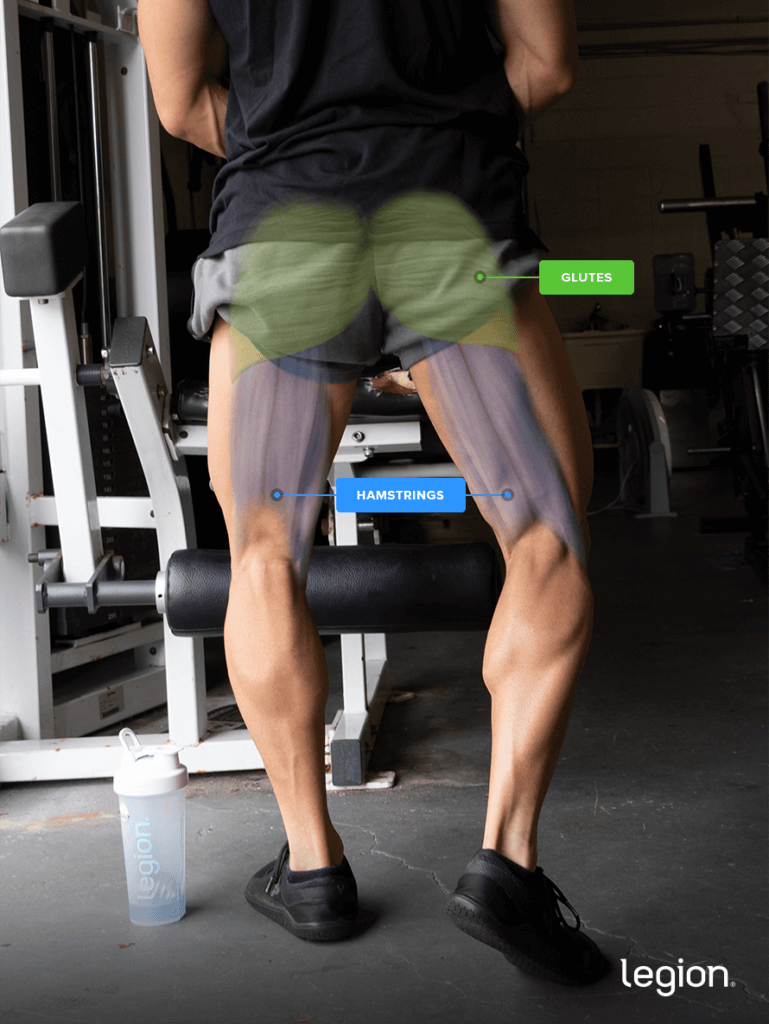
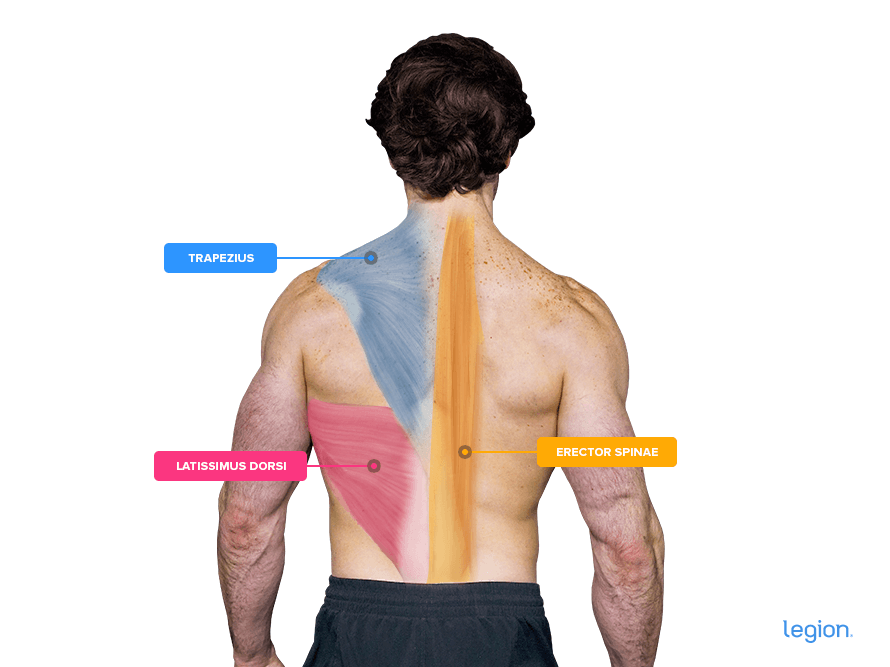
The main muscles worked by the Romanian deadlift are your hamstrings, glutes, and erector spinae (the muscles that run up either side of your spine). It also trains your lats, traps, and forearms to a lesser degree.
If you struggle to feel your hamstrings and glutes working, the usual fix is to lower the bar a bit less. Going too deep forces your knees to bend and your lower back to round, which shifts the load onto your quads and back instead. Lower only until you feel a deep stretch in your hamstrings—usually right around your kneecaps—and no farther.
There’s one more thing worth knowing about your hamstrings. They do two jobs: they extend your hips (which is what the RDL trains) and they flex your knees (which the RDL doesn’t train).
Three of your four hamstring muscles cross both the hip and the knee, but one of them—the short head of the biceps femoris (the part closer to the outside of your thigh)—only crosses the knee. That means it barely does anything during a hip hinge like the RDL.
For example, researchers at Nantes Université in France compared the stiff-leg deadlift (a close cousin of the RDL) and the Nordic curl (a knee-flexion exercise) and found they grew different parts of the hamstrings.
The stiff-leg deadlift built up one inner-hamstring muscle more (the semimembranosus), and the knee-flexion exercise better developed the semitendinosus.
The differences weren’t massive—both exercises train all portions of your hamstrings to some degree—but if you want to develop every portion of your hamstrings optimally, it’s best to use both kinds of exercises. Put simply, make sure your program includes some kind of hip hinge exercise like an RDL and some kind of knee flexion exercise like a seated or lying leg curl or Nordic curl.
3 Romanian Deadlift Workouts
Here are three sample workouts that program the Romanian deadlift the way I’d set it up for a coaching client. Each one pairs the RDL with a knee-flexion exercise (a leg curl or Nordic curl) so you train every part of your hamstrings.
Leg Day Workout with Romanian Deadlifts
Barbell Back Squat: 3 sets | 4–6 reps | 2–3 min rest
Barbell Romanian Deadlift: 3 sets | 4–6 reps | 2–3 min rest
Leg Press: 3 sets | 8–10 reps | 2–3 min rest
Seated Leg Curl: 3 sets | 8–10 reps | 2–3 min rest
In general, I like to program the RDL immediately after squats in a leg workout.
Squats still come first because they’re the most technically demanding and draining, but RDLs are a close second and primarily train your posterior chain rather than your quads and adductors (like the squat), so you should still be fresh enough to do several productive sets.
Hamstring-Focused Workout with Romanian Deadlifts
Barbell Romanian Deadlift: 3 sets | 4–6 reps | 2–3 min rest
Barbell Back Squat: 3 sets | 6–8 reps | 2–3 min rest
Lying Leg Curl: 3 sets | 8–10 reps | 2–3 min rest
Seated Calf Raise: 3 sets | 8–10 reps | 2–3 min rest
If you care more about developing your hamstrings and glutes than your quads, it makes sense to do RDLs before squats. This lets you train these muscles when you’re freshest. That said, expect your squat strength to be a bit worse if you train this way, and make sure you use proper technique—it’ll be tempting to cut corners when you’re fatigued after RDLs.
Glute-Focused Workout with Romanian Deadlifts
Hip Thrust or Hip Thrust Machine: 3 sets | 6–8 reps | 2–3 min rest
Barbell Romanian Deadlift: 3 sets | 4–6 reps | 2–3 min rest
Leg Press: 3 sets | 8–10 reps | 2–3 min rest
Lying Leg Curl: 3 sets | 8–10 reps | 2–3 min rest
If you care more about developing your glutes than your hamstrings, and you care more about developing your hamstrings than your quads, this is a great way to program the RDL.
This lets you train your glutes when you’re freshest, then train both your hamstrings and your glutes when you’re still relatively fresh (your glutes can take a lot of punishment, so stacking two glute exercises back to back generally isn’t an issue).
If you train like this, though, I generally recommend you swap squats for the leg press. It’s generally not a good idea to do heavy barbell squats after several other exercises, as it’s too hard to maintain proper technique without significantly reducing the weight on the bar. Better to just do squats on another day.
To progress any of these workouts, use double progression: work within the given rep range, and once you hit the top of the range for all of your sets, add weight.
When you bump the weight up, you’ll usually only manage a few reps at the new load. Work your way back up to the top of the range over the following workouts, then add weight again. Because a barbell lets you add as little as 2.5–5 lb. at a time, it’s the easiest way to keep this going over the long haul.
Romanian Deadlift vs. Deadlift vs. Stiff-Leg Deadlift
The Romanian deadlift and the conventional deadlift are similar exercises that train similar muscles.
The main differences are that in the Romanian deadlift, your legs stay straighter, bending only slightly at the knees as you lower the bar. You also only lower the bar to just below your knees or about midshin before standing up again (not all the way to the ground, like you do in the conventional deadlift).
This means the RDL emphasizes your hamstrings and glutes rather than your back. The conventional deadlift is more of a jack-of-all-trades, whereas the RDL is better thought of as a heavy isolation exercise for your hamstrings and glutes.
The conventional deadlift does train more total muscle—one study directly comparing the two lifts found it produced more muscle activation than the RDL. But it’s also far more punishing, which is why even advanced powerlifters rarely pull heavy more than once a week.
Personally, I’ve found that the RDL gets you most of the benefits of the conventional deadlift, but tends to result in less wear and tear and be easier to recover from.
That said, there’s no reason to choose just one of these exercises. The best solution for most people is to include both in your program, or rotate between the two of them over time.
A good way to do this is to program the Romanian deadlift after another fatiguing lower-body exercise, like the squat, on a day you aren’t doing another deadlift variation (this lets you train all of your “deadlift muscles” at least twice per week).
Or you can do the conventional deadlift for a few months, then swap it for the Romanian deadlift, and alternate like this over months and years.
The stiff-leg deadlift is a third variation, almost identical to the Romanian deadlift except the bar starts and finishes each rep on the floor. Research shows it’s a good deadlift variation for glute, hamstring, and lower-back development because it has a long range of motion.
However, most people can’t lift as much weight using the stiff-leg deadlift as they can with the RDL, it can be uncomfortable if you don’t have good flexibility or if you have lower-back issues, and it can be difficult to learn. This is why most people prefer the Romanian deadlift, and why it’s the variation I recommend in my programs for men and women.
More Hamstring and Glute Exercises
- The Best Way to Do the Dumbbell Romanian Deadlift
- The 5 Best Hamstring Exercises for Stronger, More Defined Legs
- How to Do the Nordic Hamstring Curl: Alternatives, Benefits, and Muscles Worked
- How to Do the Leg Curl: Muscles Worked, Form & Alternatives
- How to Do the Barbell Hip Thrust: Form, Mistakes & Alternatives
- The 3 Best Glute Workouts and Exercises for Women
The post The Best Way to Do the Barbell Romanian Deadlift appeared first on Legion Athletics.
https://ift.tt/9kqYyUx July 23, 2026 at 05:00PM Legion Athletics


Comments
Post a Comment