TDEE Calculator for Weight Loss
Use the Legion TDEE Calculator to calculate your total daily energy expenditure (TDEE)—an estimate of how many calories you burn each day based on your body weight, height, age, and activity level.
What Is TDEE?
TDEE, or total daily energy expenditure, is the total amount of energy you expend every 24 hours, expressed in calories.
There are four main components of TDEE:
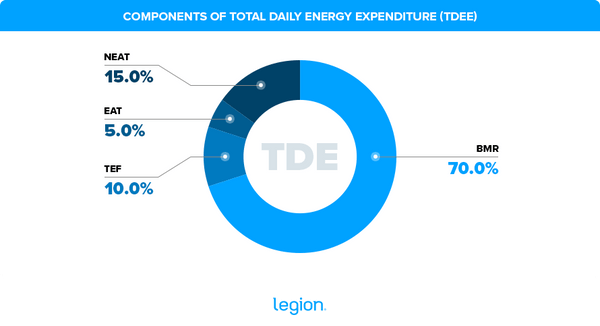
- Basal metabolic rate (BMR): BMR is the number of calories your body burns performing basic vital functions, such as breathing, pumping blood around your body, and maintaining brain function. It accounts for around 70% of TDEE.
- Thermic effect of food (TEF): TEF is the number of calories you burn digesting food. On average, TEF accounts for around 10% of your TDEE, though this can vary depending on the types of food you eat. For instance, protein has a TEF of ~20-to-30%, carbs have a TEF of ~5-to-10%, and fat has a TEF of ~0-to-3%.
- Exercise activity thermogenesis (EAT): EAT is the number of calories you burn doing formal exercise. For most people, EAT contributes approximately 5% to TDEE.
- Non-exercise activity thermogenesis (NEAT): NEAT is the number of calories you burn from any physical activity that isn’t formal exercise (the calories you burn going about daily activities, basically). It accounts for around 15% of TDEE for most people.
People primarily use the information provided by a TDEE calculator to lose weight, gain muscle, or maintain their physique.
They do this by manipulating their calorie intake based on the following three premises:
- Eating more than your TDEE causes weight gain: If you consistently eat more than your TDEE, you’ll gain weight both in the form of body fat and lean body mass (primarily muscle). To gain muscle while accumulating as little fat as possible, aim to eat 5-to-10% above your TDEE.
- Eating less than your TDEE drives fat loss: You’ll lose weight if you consistently eat fewer calories than your TDEE. Provided you eat adequate protein and lift weights, most of the weight you lose will be fat. To lose fat quickly and healthily, eat 20-to-25% fewer calories than your TDEE.
- Matching your caloric intake to your TDEE aids weight maintenance: Aligning your daily calorie intake with your energy expenditure allows you to maintain your weight. Maintaining your weight is a good option for those who have reached their goal physique and no longer want to bulk or cut.
How to Calculate TDEE
The easiest way to calculate your TDEE is to use the total daily energy expenditure calculator above.
However, if you want to crunch the number yourself, start by calculating your BMR.
There are several equations for this, but I suggest the Mifflin-St Jeor equation:
For men: BMR = 10 x weight (kg) + 6.25 x height (cm) – 5 x age (years) + 5
For women: BMR = 10 x weight (kg) + 6.25 x height (cm) – 5 age (years) – 161
I favor the Mifflin-St Jeor equation over other formulas, like the Harris-Benedict or Katch-McArdle equations, as it generates accurate results without requiring much math or your body fat percentage.
The next step is accounting for the additional energy expenditure by applying activity multipliers. To do this, multiply your BMR by the multiplier below that best describes your activity level:
- Sedentary: 1.2
- Lightly Active: 1.375
- Moderately Active: 1.550
- Very Active: 1.725
- Extra Active: 1.9
These multipliers feature in most TDEE calculators and have undoubtedly helped many people with maintaining, gaining, and losing weight. However, based on my experience assisting tens of thousands of people, these multipliers often overestimate your energy expenditure.
In other words, if you use the above multipliers, you’ll probably place yourself in too small of a calorie deficit when cutting (resulting in less-than-optimal fat loss) and too large of a surplus when bulking (resulting in more-than-optimal fat gain).
Therefore, I recommend using lower activity multipliers.
Here’s how I do it:
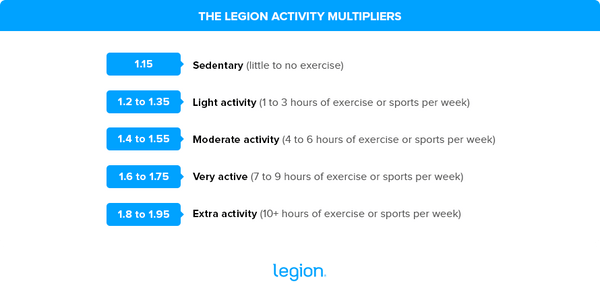
Those multipliers should give you a more accurate starting point, and they’re what we built into the Legion TDEE Calculator.
The post TDEE Calculator for Weight Loss appeared first on Legion Athletics.
https://ift.tt/HcXeOaG August 22, 2023 at 06:00PM Legion Athletics


Comments
Post a Comment