The Best Way to Do the Seated Dumbbell Overhead Press
- Instructions
- Expert Tips
- Mike's Take
- Dumbbell Shoulder Press Alternatives
- 3 Dumbbell Shoulder Press Workouts
- Dumbbell vs. Barbell Shoulder Press
- Muscles Worked by the Dumbbell Shoulder Press
- More Shoulder Exercises and Workouts
Table of Contents
+Instructions
- While sitting on an upright bench, hold a dumbbell in each hand and rest them on your thighs. Nudge the dumbbells with your thighs and hoist them just above your shoulders with your palms facing away from you.
- Press your mid and upper back against the backrest, push your chest out, and pull your shoulder blades together and down.
- Press the dumbbells toward the ceiling until your elbows are almost locked, allowing the dumbbells to drift toward each other as your elbows straighten.
- Keep your mid and upper back pressed into the backrest, and avoid excessively arching your lower back or letting your butt scoot forward on the bench.
- Reverse the movement and return to the starting position.
Expert Tips
- Imagine “punching the dumbbells into the ceiling.” This helps you lift more weight and focus on pressing the dumbbells straight up, preventing them from smacking into one another at the top of each rep. (Note: weightlifting cues that draw your attention to how your movements relate to your environment—in this case the dumbbells and the ceiling—are almost always more effective than ones that focus on your own body movement or position, such as “drive your hands up over your head.”)
- As you press the weight upward, let your elbows drift forward slightly if that’s more comfortable for you. Don’t worry about keeping your upper arms perfectly flared out to the side through the whole rep.
- Don’t cheat by shortening the range of motion. For example, only lowering the dumbbells to about eye level or partially extending your arms overhead. While this makes it easier to press heavier weights, it also makes the exercise less effective. Use weights that allow you to complete full reps before progressing. Give your body time to grow bigger and stronger, and don’t rush the process by compromising your technique.
- If your lower back arches excessively, you’re shifting around on the bench, or your butt scoots forward as you press, the weight is too heavy. Drop the weight to something you can press without squirming and work back up.
- Many people are stronger on one side of their body than the other, and thus struggle to press the dumbbells symmetrically. Choose dumbbells that are light enough to complete full reps with your weaker side. They may feel too light for your stronger side, but over time, your weaker side will catch up to your stronger side so that you can straighten both arms equally.
Mike’s Take
The dumbbell shoulder press (also called the dumbbell overhead press) is an excellent exercise for developing strong, symmetrical shoulders.
That’s why it’s one of the shoulder exercises I include in both of my programs for men and women, Bigger Leaner Stronger and Thinner Leaner Stronger.
It’s particularly effective for training the front and lateral deltoids, which are most responsible for the size and shape of your shoulders. It’s also safe, easy to learn, and requires minimal equipment.
There are two versions of the dumbbell shoulder press: the seated shoulder press and the standing shoulder press.
While some evidence shows the standing version activates your shoulder muscles slightly more than the seated dumbbell press, I recommend doing the seated version because it lets you lift heavier weights, which likely offsets any benefit of higher muscle activation.
The seated shoulder press is also easier to learn, set up, and perform.
A good default is 3 sets of 4–6 or 6–8 reps with 2–3 minutes of rest, taking each set 1–2 reps shy of failure.
It’s best to program it as part of a shoulder, push, or upper-body day in place of any other overhead pressing exercise.
Dumbbell Shoulder Press Alternatives
If the dumbbell shoulder press bothers your shoulders or you just want to try something different, these are the best alternatives:
- Arnold Press: Because of the way you rotate your wrists, you train your lateral delts slightly more than with other overhead presses, helping you develop proportional shoulders. The downside is you also can’t press as much weight with the Arnold press.
- Machine Shoulder Press: The machine shoulder press better isolates your shoulder muscles and makes it harder to cheat on the exercise, but also doesn’t train your stabilizing muscles as much as the dumbbell shoulder press.
- Seated Barbell Overhead Press: This is essentially the same exercise, but performed with a barbell. It allows you to press heavier weights but is also more of a pain to set up.
- Standing Barbell Overhead Press: This requires more coordination and balance, but also allows you to press heavier weights.
- Barbell Push Press: This is almost identical to a standing barbell overhead press, except you do a little quarter squat to help press the weight upward. It allows you to use the heaviest weight, but also doesn’t isolate the shoulder muscles and triceps as well as the other exercises on this list.
- Landmine Press: Trains one side of your body at a time, so it helps you spot and fix imbalances—and the diagonal pressing path is easier on cranky shoulders. Not my favorite variation as it can be awkward to set up and perform, but it’s a viable option.
3 Dumbbell Shoulder Press Workouts
Here are three sample workouts that show how to program the dumbbell shoulder press, whether you train it on a dedicated shoulder day, a push day, or at home with nothing but dumbbells.
Shoulder Workout with the Dumbbell Shoulder Press
Seated Dumbbell Shoulder Press: 3 sets | 6–8 reps | 2–3 min rest
Dumbbell Lateral Raise: 3 sets | 8–10 reps | 2–3 min rest
Dumbbell Rear Delt Fly: 3 sets | 8–10 reps | 2–3 min rest
Face Pull: 3 sets | 8–10 reps | 2–3 min rest
The press comes first because it’s the most demanding exercise, which lets you go heaviest while you’re fresh.
The lateral raise, rear delt fly, and face pull then round out your side and rear delts, which pressing alone doesn’t fully train.
Push Day Workout with the Dumbbell Shoulder Press
Barbell Bench Press: 3 sets | 4–6 reps | 2–3 min rest
Seated Dumbbell Shoulder Press: 3 sets | 6–8 reps | 2–3 min rest
Incline Dumbbell Bench Press: 3 sets | 8–10 reps | 2–3 min rest
Triceps Pushdown: 3 sets | 8–10 reps | 2–3 min rest
On a push day, the dumbbell shoulder press is your vertical press, slotted in after the heaviest horizontal press while your shoulders are still relatively fresh.
Dumbbell-Only Upper-Body Workout
Dumbbell Bench Press: 3 sets | 6–8 reps | 2–3 min rest
Seated Dumbbell Shoulder Press: 3 sets | 6–8 reps | 2–3 min rest
One-Arm Dumbbell Row: 3 sets | 6–8 reps | 2–3 min rest
Dumbbell Lateral Raise: 3 sets | 8–10 reps | 2–3 min rest
If you train at home with only dumbbells, this hits your whole upper body, and the shoulder press is the anchor of it. No upright bench? Do the standing version instead.
Dumbbell-only training works well up to a point—the catch is progression, since most dumbbell sets increase in 5-pound increments and top out around 100 pounds. It’s fine for getting started and reaching a moderate level of strength and muscularity, but not to keep progressing long-term.
To progress any of these workouts, use double progression: work within the given rep range, and once you hit the top of the range for your first set, add weight.
Dumbbell vs. Barbell Shoulder Press
Similarly to the overhead and military press, the dumbbell shoulder press involves pressing weights from shoulder height overhead, then lowering them to shoulder height again. The difference is that you perform the shoulder press with dumbbells rather than a barbell.
Using a barbell instead of dumbbells for the seated shoulder press enables most people to press about 10-to-20% more weight and progress to heavier weights faster, which is great for building muscle and strength.
The downside is that it’s more hassle to set up.
The standing barbell version—the overhead press—is also outstanding: in addition to improving upper-body strength and shoulder, trap, triceps, and upper chest size, it develops your whole-body balance and coordination.
There’s no reason to pick just one. A simple approach that works well: press with a barbell on one upper-body or push day each week, and with dumbbells on another. Or rotate between the two exercises every few months.
Muscles Worked by the Dumbbell Shoulder Press
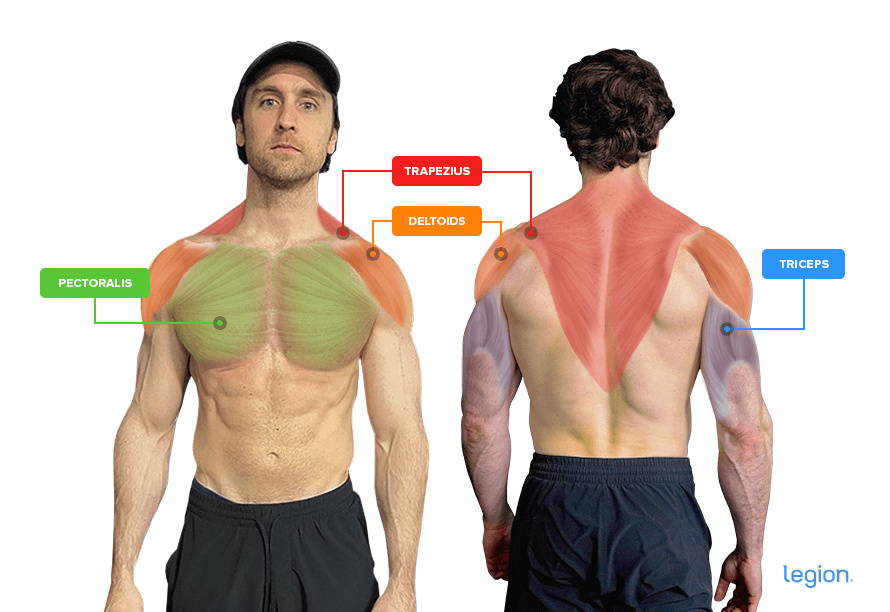
The main muscles worked by the dumbbell shoulder press are the . . .
- Deltoids
- Triceps
- Pectoralis major and minor
It also trains the abs, biceps, forearms, traps, serratus anterior, and rotator cuff muscles to a lesser degree.
One thing worth knowing: like all overhead pressing, the dumbbell shoulder press mostly trains your front and lateral (side) delts—your rear delts barely at all.
That’s why the shoulder workout above pairs it with a lateral delt exercise like the lateral raise and a rear delt exercise like the rear delt fly—that combination trains all three parts of your shoulders, which is what actually produces round, proportional “3D” shoulders.
More Shoulder Exercises and Workouts
- The Best Full Shoulder Workouts for Building Size and Mass
- The Best Dumbbell Shoulder Exercises & Workouts for Mass
- How to Do the Seated Arnold Press: Form & Variations
- How to Do the Overhead Press: Muscles Worked, Form, and Alternatives
- The Best Way to Do Lateral Raises for Defined Delts
The post The Best Way to Do the Seated Dumbbell Overhead Press appeared first on Legion Athletics.
https://ift.tt/i2X7gnx July 27, 2026 at 06:00PM Legion Athletics


Comments
Post a Comment