The Best Way to Do the Barbell Overhead Press
- Instructions
- Expert Tips
- Mike's Take
- Overhead Press Alternatives
- 3 Overhead Press Workouts
- Overhead Press vs. Military Press vs. Shoulder Press
- Muscles Worked by the Barbell Overhead Press
- More Shoulder Exercises and Workouts
Table of Contents
+Instructions
- Adjust the hooks in a power rack or squat rack so the bar is at the height of your midchest, slightly below your collarbones. Face the bar and grip it with your palms facing forward and thumbs wrapped around the bar, slightly wider than shoulder-width.
- Hold the bar low in your hands, closer to your wrists than your fingers, with your wrists bent just enough to let the bar settle into the base of your palms (not folded back at a 90-degree angle).
- Bend your knees slightly and position the bar on top of your shoulders and upper chest, then stand up to lift the bar off the rack and take one step back with each foot.
- Take a deep breath into your stomach, arch your upper back enough that the bar is directly over your midfoot and your head is slightly behind the bar, squeeze your glutes and the bar as hard as you can, and push the bar straight up.
- As soon as the bar passes your eyes, push your head and chest forward and under the bar. Keep pushing until your arms are straight, then lower the bar and return to the starting position.
Expert Tips
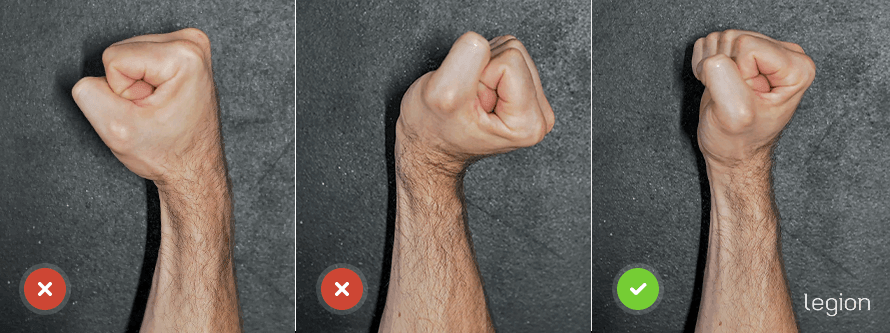
- Avoid letting your wrists bend backwards during each rep. Instead, try to keep your wrists in a relatively neutral position with the bar positioned over your forearm, as shown above.
- One of the best cues for improving your overhead press technique and strength is to think about “pushing your chest through the window” right as the bar reaches eye height. The bar and your forearms create a little square (which you can think of as a window) and you should think about forcing your chest through this space.
- Keep your hands in line with or just outside your shoulders, so your forearms are parallel with one another and perpendicular to the bar (when viewed from the front). Pressing with a much wider grip makes the beginning of each rep harder than it should be, makes it more difficult to stabilize your torso once the bar clears your head, and reduces the range of motion, which reduces the overall effectiveness of the exercise.
- Before each rep, take a deep breath that fills your lungs to about 80% of their maximum capacity, press your tongue against the roof of your mouth, and tighten your core muscles as if you were about to get punched in the gut. This creates intra-abdominal pressure that stabilizes your body and keeps your torso rigid—don’t let the air out until you’re past the hardest part of the lift. (Here’s a complete guide to bracing if you want to go deeper.)
- Imagine “throwing the bar into the ceiling.” Weightlifting cues that draw your attention to how your movements relate to your environment—in this case the bar and the ceiling—are almost always more effective than ones that focus on your own body movement or position (like “straighten your arms”).
- Don’t let the barbell fall back to the starting position or try to lower it slowly—the entire descent should be controlled but take less than a second.
- Squeeze your glutes as hard as you can—this is one of the best cues for keeping your entire body tight throughout every rep (and yes, this is an exception to the “rule” above about weightlifting cues
 ).
).
Mike’s Take
While the overhead press isn’t considered one of the “Big 3” exercises in powerlifting (the squat, bench press, and deadlift), it features heavily in other strength sports such as Olympic weightlifting, CrossFit, and strongman because few exercises are a better indicator of upper-body strength.
As such, it can also be an excellent exercise for gaining muscle and strength, which is why it’s one of the primary upper-body exercises in my training programs for men and women, Bigger Leaner Stronger and Thinner Leaner Stronger.
Now, why did I say the overhead press can be an excellent exercise for gaining muscle and strength?
Well, for some people it is, but for others it does very little.
For one thing, it mostly trains your front delts, which are already trained hard by the bench press, dumbbell bench press, and every other horizontal or incline pressing or fly movement.
Secondly, your triceps often fatigue before your shoulders do, which makes this more of an arm exercise than a shoulder exercise (which isn’t entirely a bad thing—it trains both muscle groups simultaneously).
Finally, many people find the exercise doesn’t play nicely with their anatomy, and they grind for years with little muscle growth to show for it.
This isn’t to say the overhead press is a “bad” exercise. It’s one of the main exercises that helped me build my shoulders and triceps and it’s done the same for the majority of people I’ve helped through my books and coaching program.
But if it doesn’t suit you, swap it for one of the alternatives below.
For my part, I prefer the seated overhead press for most of my training because my heavy deadlifting, rowing, and squatting is more than enough for training my core and back. Thus, when I’m training shoulders, I want to focus on them as much as possible.
I also prefer the barbell overhead press over the dumbbell overhead press for several reasons. A barbell requires less coordination, which makes it easier to handle heavy weights; it’s easier to set up, so you don’t have to waste energy or risk injury getting heavy dumbbells into position; and it allows you to add weight in smaller increments, which is important for long-term progress.
It’s worth noting that the standing barbell overhead press might be a better pick if you’re focused on overall athleticism. The reason for this is that it’s a closed-kinetic-chain exercise—your feet are planted on the floor rather than your body being supported by a bench or machine.
Experts generally agree that closed-kinetic-chain exercises are better at boosting sports performance than open-kinetic-chain exercises like the bench press. They help you develop greater balance and stability, more closely mimic the movements involved in sports, and train more “stabilizer” muscles.
But if your goal is just gaining muscle and strength as quickly and efficiently as possible, this is irrelevant (and there’s a strong argument, which I subscribe to, that you’ll probably improve your athleticism more doing your primary sport than anything you can do in the weight room).
In terms of programming, a good default is 3 sets of 4–6 reps with 2–3 minutes of rest, taking each set 1–2 reps shy of failure. It’s best to program the overhead press as part of a shoulder, push, or upper-body day in place of any other overhead pressing exercise.
Progress on the overhead press is also slower and more sporadic than on most other exercises—it’s a challenging, technical lift that trains a relatively small muscle group, so expect slow, stubborn progress.
And like I said, if you find yourself pounding away at it with little progress, despite eating properly, getting enough sleep, and so on, there’s no shame in simply using other exercises to train your shoulders and triceps.
Overhead Press Alternatives
- Seated Barbell Overhead Press. Performing the exercise seated enables you to press about 10-to-20% more weight and progress to heavier weights faster, but it’s less demanding on your core, lower back, and glutes, making it better for isolating your shoulders and triceps but less of a full-body exercise. I prefer this variation, personally.
- Dumbbell Overhead Press. Some people find this more comfortable, and some research shows it activates the deltoids more, but it’s also more awkward to set up and perform, especially if you do it standing.
- Arnold Press. Some research shows this activates the front and lateral deltoids more than the dumbbell overhead press, but otherwise they’re more or less interchangeable in your workouts.
- Machine Shoulder Press. One of my favorite overhead press alternatives. Using a machine requires less balance and coordination, which allows you to more effectively isolate the shoulders and triceps.
- Incline Barbell Bench Press. This exercise trains almost all of the same muscles, but emphasizes the chest more than the lateral deltoids. I like to combine this exercise with lateral raises for training my pressing muscles.
- Incline Dumbbell Bench Press. Identical to the incline barbell bench press, but requires more balance and coordination.
- Push Press. This is just an overhead press where you use just enough leg drive to get the bar off your shoulders. Basically, you use your legs to build momentum and “cheat” to get the bar through the hardest part of the rep. It’s fine if you want to challenge yourself and throw around heavier weights, but it’s not ideal from a muscle-building standpoint.
- Single-Arm Dumbbell Overhead Press. Skip this. There’s essentially no benefit, and it’s awkward to get into position and press the weight.
- Smith Machine Overhead Press. A viable option if your gym doesn’t have a barbell, but most people find the fixed bar path uncomfortable.
- Landmine Press. This is a viable option if your gym doesn’t have barbells, dumbbells, or machines, but it doesn’t offer any meaningful advantages over the other exercises on this list.
- Behind-the-Neck Press. Don’t do this. It offers no advantage over other overhead pressing exercises and forces your shoulders into an unstable, awkward position.
3 Overhead Press Workouts
Here are three sample workouts that show how to program the overhead press, whether you train it on a dedicated shoulder day, a push day, or as part of a full-body routine.
Shoulder Workout with the Overhead Press
Barbell Overhead Press: 3 sets | 4–6 reps | 2–3 min rest
Incline Barbell Bench Press: 3 sets | 6–8 reps | 2–3 min rest
Dumbbell Lateral Raise: 3 sets | 8–10 reps | 1–2 min rest
Dumbbell Rear Delt Fly: 3 sets | 8–10 reps | 1–2 min rest
Push Day Workout with the Overhead Press
Barbell Bench Press: 3 sets | 4–6 reps | 2–3 min rest
Barbell Overhead Press: 3 sets | 4–6 reps | 2–3 min rest
Incline Dumbbell Bench Press: 3 sets | 8–10 reps | 2–3 min rest
Triceps Pushdown: 3 sets | 8–10 reps | 1–2 min rest
Full-Body Workout with the Overhead Press
Barbell Back Squat: 3 sets | 4–6 reps | 2–3 min rest
Barbell Romanian Deadlift: 3 sets | 4–6 reps | 2–3 min rest
Barbell Overhead Press: 3 sets | 4–6 reps | 2–3 min rest
Seated Cable Row: 3 sets | 6–8 reps | 2–3 min rest
To progress any of these workouts, use double progression: use a weight that allows you to work within the given rep range, take each set 1–2 reps shy of failure and once you hit the top of the range for your first set, add weight.
Overhead Press vs. Military Press vs. Shoulder Press
You’ll often see people use the terms “military press” and “overhead press” interchangeably, but there’s no official definition for these terms.
Some experts (including strength coach and author of Starting Strength, Mark Rippetoe) distinguish the two based on how much your lower body moves during the exercise. According to them, if your hips and back move, it’s an overhead press, and if your body remains almost motionless (apart from your arms moving overhead), it’s a military press.
For what it’s worth, I favor “overhead press” because it’s more descriptive than “military press.”
In practice, when people say “military press,” they’re usually referring to what’s also called a standing barbell overhead press. Unless someone specifies the use of dumbbells or being seated instead of standing, it’s safe to assume the “military press” they’re referring to is the standing barbell variation.
As for the dumbbell shoulder press, neither exercise is better or worse than the other. Although both exercises feel quite different, they train the same muscles to a similar degree, so you can use them interchangeably in your workouts.
That said, the dumbbell shoulder press tends to require more balance and coordination, which can make it harder to use heavy weights and progress over time. Thus, I typically favor the barbell overhead press or machine overhead press instead of the dumbbell version.
Of course, there’s no reason to choose just one. You can include the barbell overhead press in your program for 6-to-8 weeks of training, take a deload, then replace it with the dumbbell shoulder press for the following 6-to-8 weeks of training.
Then, you can either continue alternating between the exercises every few months like this or stick with the one you prefer.
Muscles Worked by the Barbell Overhead Press
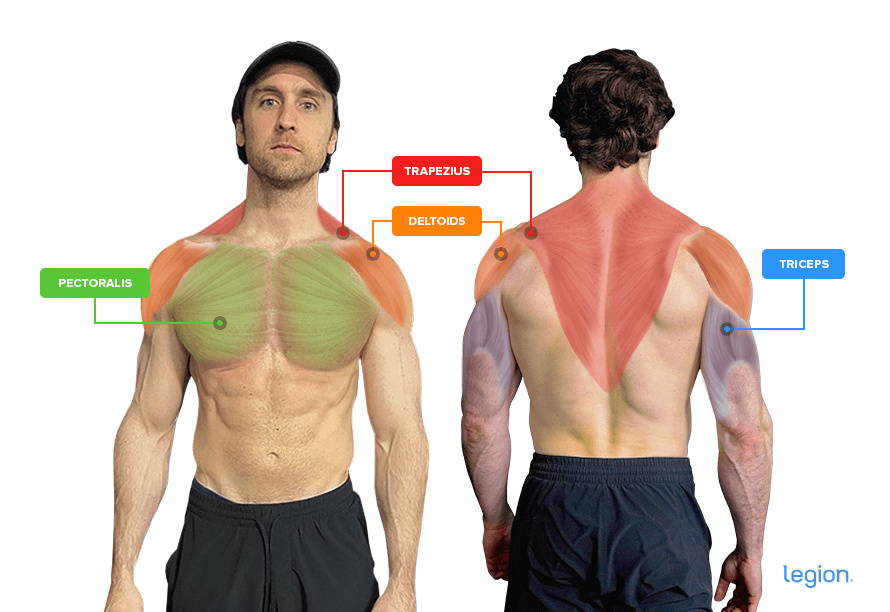
The main muscles worked by the barbell overhead press are the . . .
- Deltoids
- Trapezius
- Triceps
- Forearms
- Pectoralis major and minor
The overhead press trains all three heads of the deltoids to a high degree, though like all overhead pressing, it emphasizes your front and lateral delts far more than your rear delts.
That’s why the shoulder workout above pairs it with a lateral raise and a rear delt fly—that combination trains all three parts of your shoulders, which is what actually produces round, proportional “3D” shoulders.
The barbell overhead press also trains your chest. It involves shoulder flexion (moving your arms from your sides to above your head by lifting them in an arc in front of you), and one of the main muscle groups responsible for shoulder flexion is the pecs (particularly the clavicular head of the pecs, or “upper chest“).
What’s more, the stronger you get on the overhead press, the more you’ll need to involve other muscle groups like your lats, rhomboids, serratus anterior, abs, glutes, and legs to stabilize your body, making it a full-body exercise when using heavier weights.
Although as I noted above, this also means that if one of these muscle groups fails before your triceps and shoulders are fully trained, it makes the exercise less effective for growing these two muscle groups.
More Shoulder Exercises and Workouts
- The 5 Best Shoulder Workouts and 8 Best Exercises (According to Science)
- The Best Way to Do the Seated Dumbbell Overhead Press
- How to Do the Seated Arnold Press: Form & Variations
- The Best Way to Do Lateral Raises for Defined Delts
- The Best Dumbbell Shoulder Exercises & Workouts for Mass
The post The Best Way to Do the Barbell Overhead Press appeared first on Legion Athletics.
https://ift.tt/g1Ls0wl August 7, 2026 at 06:00PM Legion Athletics


Comments
Post a Comment