The Best Way to Do Cable Crunches for Stronger, More Defined Abs
- Instructions
- Expert Tips
- Mike's Take
- Cable Crunch Alternatives
- Kneeling vs. Standing Cable Crunch: Which Should You Do?
- 3 Cable Crunch Workouts
- Muscles Worked by the Cable Crunch
- More Ab Exercises
Table of Contents
+Instructions
- Set the pulley of a cable machine to the highest position, attach a rope handle, and put a pad on the floor to protect your knees.
- Kneel facing the machine, grip the rope with both hands, and pull it down so your hands are roughly at the level of your ears and your elbows are bent.
- Crunch your torso down toward your thighs by contracting your abs and rounding your upper back, keeping your hips and arms fixed.
- Reverse the movement and return to the starting position, allowing your spine to arch slightly until you feel a stretch in your abs.
Expert Tips
- Keep your hips and knees locked in the same position throughout each rep. The only part of your body that should be moving is your upper torso. The number one mistake people make when doing the cable crunch is hip flexion—moving their abdomen closer to their thighs. While this feels like it’s increasing the range of motion of the exercise, which is typically a good thing, this primarily trains your hip flexors, not your abs. If you’re used to bending forward at the waist while doing the cable crunch, then this will feel strange at first, but it’s the best way to ensure this exercise truly targets your abs.
- A good cue for the cable crunch is to imagine curling your chest toward your bellybutton. This helps you posteriorly tilt your pelvis, which research shows better activates your abs.
- If you can’t do the exercise in this manner, reduce the weight until you can. Don’t sacrifice technique to use heavier weights.
- You’ll still sometimes hear people say that cable crunches are bad for your spine. An old saw many personal trainers like to repeat is that “your spine is like a credit card, and if you keep bending it, eventually it wears out.” This is completely wrong. While it’s true that lifting heavy weights with a rounded back can be dangerous, the cable crunch is an entirely different movement (pulling down against resistance) which doesn’t put a meaningful amount of force on your vertebrae or the ligaments in your spine. What’s more, the forces involved are much lower than what you’d encounter in an exercise like the deadlift. So long as you follow the steps in this article, cable crunches are a perfectly safe exercise.
- Lower and raise your torso under control, and pause for a brief second at the bottom of each rep (in the crunched position). This ensures you aren’t using momentum to make the exercise easier and keeps tension on your abs throughout each rep.
- Don’t pull with your arms. Keep your arms stationary and use your abs to pull your torso toward your thighs.
Mike’s Take
The cable crunch is one of the few ab exercises I recommend in my programs for men and women, Bigger Leaner Stronger and Thinner Leaner Stronger.
Here’s why:
- It allows you to add weight in small increments (progressive tension overload), which is the key to building muscle. Most ab exercises like the hanging leg raise, crunch, and ab wheel rely on body weight instead, which makes it much more difficult to add load like you can with the cable crunch.
- It allows you to effectively isolate your abs. Many ab exercises, like the weighted sit-up, hanging leg raise, and plank rely on other muscles that often fatigue faster than your abs, like the hip flexors (sit-up and plank) or forearms (hanging leg raise).
- You can do it in basically any gym in the world. All you need is a cable machine and a handle. I prefer the rope handle but you can also use a V-grip, EZ-bar handle, or even a lat pulldown bar in a pinch.
The only real downside of the cable crunch is that some cable machines force you to progress in large increments—sometimes as much as 10–20 pounds. But, that’s still better than not being able to add weight at all.
I generally like to program the cable crunch for 2–3 sets of 10–12 reps, taking each set to muscular failure, with 1–2 minutes rest between sets. As with most exercises, I like to progress using double progression: once you hit the top of the target rep range for your first set (12 in this case), add weight.
Three more notes on training your abs generally:
- You must lose body fat if you want to get six pack abs. Research shows that no amount of cable crunches or any other ab exercise will give you visible abs if your body fat percentage is too high. Get lean: under ~12% body fat for men and ~20% body fat for women.
- The abs are partially stimulated by compound exercises like squats, deadlifts, and chin-ups, and it’s entirely possible to get six pack abs without doing any direct ab training (if you’re lean enough). That said, your abs respond to strength training like any other muscle—by getting bigger and stronger. And training them directly with exercises like the cable crunch can make them “pop” a bit more and improve the overall appearance of your upper body.
- Both of these points work synergistically: The leaner you get, the more your abs show through, and the more small increases in abdominal muscle mass become magnified.
Cable Crunch Alternatives
- Ab crunch machine. The best substitute. This is essentially the same movement but using a machine instead.
- Decline weighted sit-up. This exercise also allows you to add weight in small increments, but it tends to rely more on the hip flexors and thus isn’t as effective at isolating the abs.
- Ab wheel rollout. Despite being a body weight exercise, this is challenging enough that it’s still very effective for training your abs.
- Captain’s chair leg raise. This is almost as challenging as the ab wheel rollout, which makes it a good alternative. That said, once you can do 15 or more reps, you’re better off graduating to a harder exercise, as adding weight becomes impractical.
- Captain’s chair knee raise. The easier version of the captain’s chair leg raise. Use this until you can get 10 strict reps, then progress to the captain’s chair leg raise.
- Hanging leg raise. The same movement as the captain’s chair leg raise, but it also trains your grip at the same time. Downside: your grip will generally fail before your abs, making it a suboptimal ab exercise.
- Reverse crunch. No equipment required and easy to learn, but also impractical to progress past the beginner stage.
- Plank. One of the more challenging bodyweight ab exercises you can do. Once you can hold this position for 1–2 minutes, though, you’re better off progressing to a weighted ab exercise like the cable crunch.
- Bodyweight crunch. This is fine when you’re new to weightlifting, but once you can do at least 20 bodyweight crunches, you’re better off switching to a weighted ab exercise like the cable crunch.
- Band crunch. This is a good option for traveling, but it’s tricky to progress as the tension changes throughout each rep and you need to use progressively stronger bands to make the exercise more challenging.
Kneeling vs. Standing Cable Crunch: Which Should You Do?
Kneeling.
The cable crunch is an ab exercise, period. Standing only makes the movement less stable, which reduces how much weight you can use and how much tension is applied to the abs, specifically.
3 Cable Crunch Workouts
Here are three sample workouts that show how to program the cable crunch, no matter what kind of workout routine you’re following.
Pull Workout with the Cable Crunch
Barbell Deadlift: 3 sets | 4–6 reps | 2–3 min rest
Chin-Up: 3 sets | 4–6 reps | 2–3 min rest
One-Arm Dumbbell Row: 3 sets | 6–8 reps | 2–3 min rest
Barbell Curl: 2 sets | 8–10 reps | 1–2 min rest
Cable Crunch: 2 sets | 10–12 reps | 1–2 min rest
Lower Body Workout with the Cable Crunch
Barbell Back Squat: 3 sets | 4–6 reps | 2–3 min rest
Barbell Romanian Deadlift: 3 sets | 6–8 reps | 2–3 min rest
Leg Press: 3 sets | 8–12 reps | 2–3 min rest
Seated Leg Curl: 3 sets | 8–12 reps | 1–2 min rest
Cable Crunch: 3 sets | 10–12 reps | 1–2 min rest
Upper Body Workout with the Cable Crunch
Barbell Bench Press: 3 sets | 4–6 reps | 2–3 min rest
Chest-Supported Row: 3 sets | 6–8 reps | 2–3 min rest
Dumbbell Lateral Raise: 3 sets | 8–12 reps | 1–2 min rest
Cable Crunch: 2 sets | 10–12 reps | 1–2 min rest
As you can see, my preferred approach is to simply tack on 2–3 sets of cable crunches to the end of your existing workouts. You don’t need to do dedicated ab workouts.
To progress these workouts, use double progression: work within the given rep range, and once you hit the top of the range for your first set, add weight.
Muscles Worked by the Cable Crunch
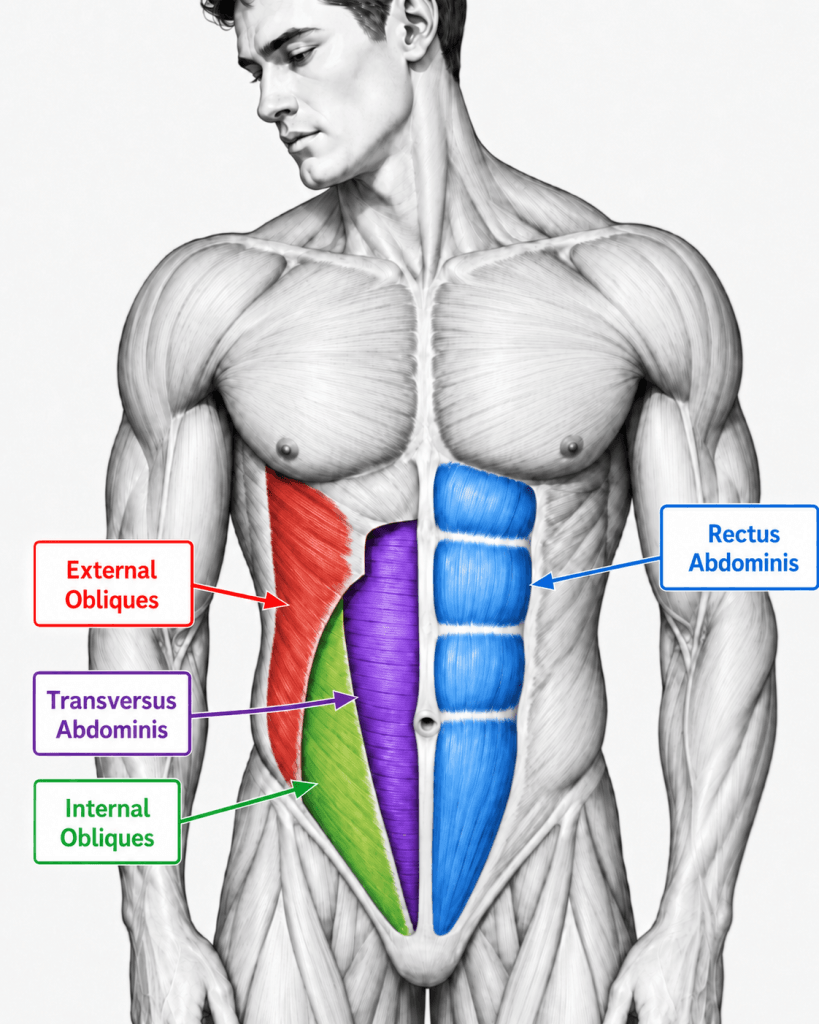
The cable crunch primarily works the rectus abdominis—the “six-pack” muscles. It also trains the internal and external obliques and transverse abdominis to a lesser degree.
The abs’ main job is to flex your spine, which is why curling your chest toward your bellybutton helps: it encourages you to round your upper back without bending forward at the waist, which forces your abs to do most of the work.
More Ab Exercises
- The 8 Best Lower Ab Workouts & Exercises (Bodyweight + Weighted)
- How to Do the Hanging Leg Raise
- The Best Ab Workout for Women (According to Science)
- How Long Does It Take to Get Six-Pack Abs?
The post The Best Way to Do Cable Crunches for Stronger, More Defined Abs appeared first on Legion Athletics.
https://ift.tt/3TywjG7 August 4, 2026 at 06:00PM Legion Athletics


Comments
Post a Comment