The Best Way to Do the Dumbbell Bench Press
- Instructions
- Expert Tips
- Mike's Take
- Dumbbell Bench Press Alternatives
- 3 Dumbbell Bench Press Workouts
- Dumbbell vs. Barbell Bench Press
- How Much Should You Be Able to Dumbbell Bench Press?
- Muscles Worked by the Dumbbell Bench Press
- More Chest Exercises and Workouts
Table of Contents
+Instructions
- Sit on the edge of the bench, holding a dumbbell in each hand, with the dumbbells resting vertically on your thighs.
- Lean back slowly and gently kick your thighs (and the dumbbells) toward your chest, rolling back onto the bench until you’re lying flat with the dumbbells at either side of your chest.
- Pull your shoulder blades together and toward your butt and push the dumbbells straight up until your arms are locked.
- Lower the dumbbells by reversing the motion and return to the starting position.
- When you’re finished with a set, either lower the dumbbells to your chest and drop them to the floor, or bring your legs up toward you, shift the dumbbells onto your thighs, and sit up by swinging your legs and dumbbells downward and your torso upward.
Expert Tips
- One of the most challenging aspects of the dumbbell bench press is getting the dumbbells into position, especially as you get stronger. Watch the video above to see the safest and most efficient way to do this.
- A good cue for getting your shoulder blades in the right position is to imagine you’re “putting your shoulder blades into your back pockets.”
- As the dumbbells rise, allow the weights to drift closer together, but don’t worry about trying to touch them. In fact, it’s better if you keep the dumbbells straight over your shoulders, as this keeps more tension on your chest throughout each rep.
- Lower the dumbbells until you feel a deep stretch in your pecs—the handles of the dumbbells should be in line with your nipples. Multiple studies show that muscles grow more when trained through a full range of motion.
- Keep your lower back slightly arched, your butt on the bench, and your feet on the floor throughout each rep.
- Allow your wrists to rotate into whatever position feels most comfortable for you—one of the benefits of the dumbbell bench press is that your wrists aren’t locked into a specific position like they are with the barbell bench press.
- Many people are stronger on one side of their body than the other, and thus struggle to press the dumbbells symmetrically. Choose dumbbells that are light enough to complete full reps with both arms.
Mike’s Take
The dumbbell bench press is one of my favorite exercises for building your chest, shoulders, and triceps, and it’s one of the chest exercises I include in both of my programs for men and women, Bigger Leaner Stronger and Thinner Leaner Stronger.
Like the barbell bench press, it trains all of your “pushing” muscles through a full range of motion and allows you to add weight in small increments.
Many people also find it more comfortable. Unlike the barbell bench press, which locks your wrists into a fixed position, the dumbbell bench press lets you rotate your wrists into whatever position is most comfortable for you. This is particularly helpful when trying to “train around” an injury, such as a wrist sprain, shoulder niggle, or elbow tendinitis.
The dumbbell bench press can also help you identify and correct muscle and strength imbalances because one side can’t “take over” or “pick up slack” from the other. That said, most of these imbalances—if they exist in the first place—tend to even out naturally over time, so I wouldn’t worry about this unless you’re certain this is a problem for you.
That said, it’s worth addressing the limitations of the dumbbell bench press, too.
First, while some people claim it’s superior to the barbell bench press because it allows you to use a greater range of motion, this isn’t really true. While you might be able to lower your hands a tad more with dumbbells than a barbell, it’s not enough to have any meaningful impact on muscle growth, and this tends to irritate people’s shoulders and elbows.
Second, it can be awkward getting the dumbbells into position at the beginning of each set and setting them down afterwards. And the stronger you get, the more energy you waste doing this.
Finally, the dumbbell bench press requires more balance and coordination than the barbell bench press, and significantly more than the machine chest press. While this means that it effectively trains a number of “stabilizer” muscles throughout your body, it also means that some of these smaller muscle groups can become limiting factors during your sets.
In other words, when you reach failure on a set, you can’t be sure whether your chest actually failed or whether one of these smaller muscles simply gave out first.
This is why I like to program the dumbbell bench press along with at least one or two other chest pressing exercises throughout the week. This gives you the benefits while allowing you to make up for the downsides with other exercises.
When it comes to programming, a good default is 3 sets of 4–6 or 6–8 reps with 2–3 minutes of rest, taking each set 1–2 reps shy of failure.
It’s best to program it as part of a chest, push, or upper-body day, either as your main press or as an accessory to the barbell bench press.
Dumbbell Bench Press Alternatives
- Barbell Bench Press. This is essentially the same exercise, but performed with a barbell.
- Incline Dumbbell Bench Press. Works just like the dumbbell bench press, except you set the bench on an incline.
- Incline Barbell Bench Press. Works just like the barbell bench press, except you set the bench on an incline.
- Machine Chest Press. Another excellent option that trains all of the same muscles and arguably isolates your pecs even better.
- Chest Dip. Trains your chest, shoulders, and triceps through a long range of motion and is easy to load with a dip belt, but it can irritate some people’s shoulders.
- Push-Up. Better than nothing, but not very effective once you’re past the beginner phase.
3 Dumbbell Bench Press Workouts
Here are three sample workouts that show how to program the dumbbell bench press, whether you train it on a dedicated chest day, a push day, or as part of a full-body workout.
Chest Workout with the Dumbbell Bench Press
Dumbbell Bench Press: 3 sets | 4–6 reps | 2–3 min rest
Incline Dumbbell Bench Press: 3 sets | 6–8 reps | 2–3 min rest
Machine Chest Press: 3 sets | 6–8 reps | 1–2 min rest
Dumbbell Chest Fly: 3 sets | 8–10 reps | 1–2 min rest
Push Day Workout with the Dumbbell Bench Press
Dumbbell Bench Press: 3 sets | 4–6 reps | 2–3 min rest
Incline Dumbbell Bench Press: 3 sets | 6–8 reps | 2–3 min rest
Triceps Pushdown: 3 sets | 8–10 reps | 1–2 min rest
Dumbbell Lateral Raise: 3 sets | 8–10 reps | 1–2 min rest
Full-Body Workout with the Dumbbell Bench Press
Barbell Back Squat: 3 sets | 4–6 reps | 2–3 min rest
Dumbbell Bench Press: 3 sets | 6–8 reps | 2–3 min rest
One-Arm Dumbbell Row: 3 sets | 6–8 reps | 2–3 min rest
Dumbbell Lateral Raise: 3 sets | 8–10 reps | 1–2 min rest
To progress these workouts, use double progression: use a weight that allows you to work within the given rep range, take each set 1–2 reps shy of failure, and once you hit the top of the range for your first set, add weight.
Dumbbell vs. Barbell Bench Press
The flat barbell bench press is widely considered to be the best exercise for gaining chest muscle and pressing strength, and this is largely true.
You can lift 17% more weight when you bench press with a barbell than when you use dumbbells, which makes it one of the most effective ways to progressively overload your chest muscles.
That said, research shows that the dumbbell bench press activates your pecs slightly more than the barbell bench press.
Now, does that mean either exercise is better than the other? Not really. Both exercises force your chest muscles to produce high levels of tension, allow for incrementally adding weight over time, and are safe and effective when performed correctly.
As noted earlier, the barbell bench press requires less balance and coordination, which can make it easier to focus on training your pecs and triceps. And some people find the dumbbell bench press a bit more comfortable.
Which you focus on largely comes down to personal preference, and there’s no reason you need to choose just one. You can stick with the dumbbell bench press for 8–10 weeks and then switch to the barbell bench press for the next 8–10 weeks, or include both in your weekly routine.
For a deeper look at how the two compare, check out this article: Barbell vs. Dumbbell Bench Press: Which Is Better for Gains?
How Much Should You Be Able to Dumbbell Bench Press?
You’ll sometimes hear that you should be able to dumbbell bench press 80% of your barbell bench press (that’s including both dumbbells).
For example, if you barbell bench press 200 pounds, you should be able to dumbbell bench press 160 pounds (80 pounds in each hand).
That’s not a bad target, but how much you can dumbbell bench press is also largely dictated by how familiar you are with the exercise—it’s a skill like any other. If you don’t do much barbell bench pressing, then use these guidelines instead:
Dumbbell bench press standards for men:
- Beginner: 0.6 times your body weight
- Intermediate: 0.9 times your body weight
- Advanced: 1.2 times your body weight
Dumbbell bench press standards for women:
- Beginner: 0.3 times your body weight
- Intermediate: 0.5 times your body weight
- Advanced: 0.7 times your body weight
Note: With these standards, “Beginner” refers to anyone who’s been consistently training for 0-to-12 months, “Intermediate” refers to anyone who’s been consistently training for 1-to-3 years, and “Advanced” refers to anyone who’s been consistently training for more than 3 years.
All strength standards refer to the minimum total weight (both dumbbells’ weight combined) you should be able to press for a single rep (one-rep max).
You can also estimate your max barbell bench press from your max dumbbell bench press using the results of a study conducted by scientists at Sogn og Fjordane University College, which found that, on average, people could lift just under 20% more weight on the barbell bench press than they could on the dumbbell bench press.
This means that if you could do one rep on the dumbbell bench press with dumbbells weighing 80 pounds each (160 pounds total), you’ll likely be able to do one rep on the barbell bench press with around 200 pounds.
Muscles Worked by the Dumbbell Bench Press
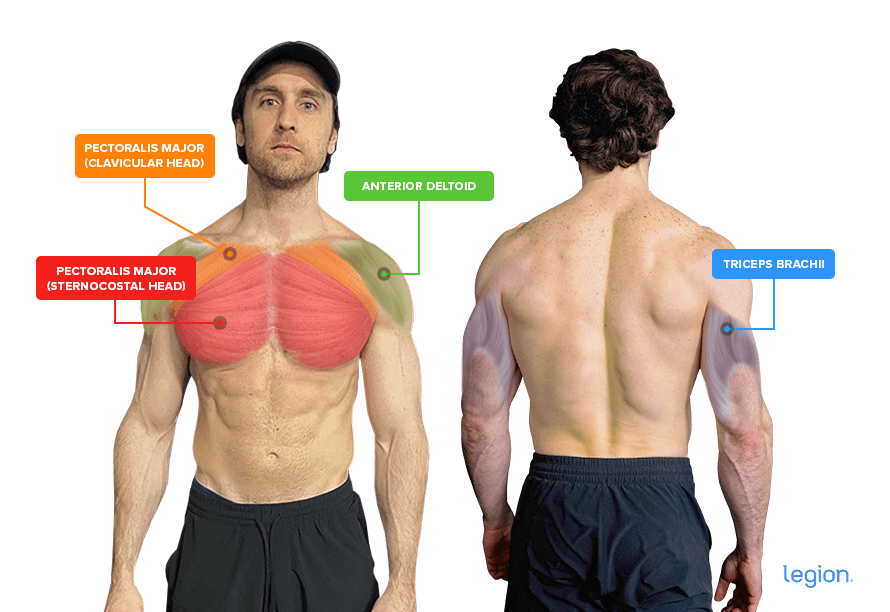
The main muscles worked by the dumbbell bench press are the . . .
- Pectoralis major (your chest, including both the sternocostal and clavicular heads)
- Anterior deltoid (your front delts)
- Triceps brachii
One thing worth knowing: flat pressing mostly trains the middle and lower portion of your pecs. Your upper chest, known as the clavicular head, is better trained by incline pressing movements, which is why the chest workout above pairs the dumbbell bench press with an incline press.
More Chest Exercises and Workouts
- Chest Workout Program for Mass: 7 Best Pec Exercises
- How to Bench Press: Expert Guide to Proper Bench Press Form
- Dumbbell Incline Press: Setting Up & Alternatives
- Barbell vs. Dumbbell Bench Press: Which Is Better for Gains?
- How to Close-Grip Bench Press: Tips & Variations
The post The Best Way to Do the Dumbbell Bench Press appeared first on Legion Athletics.
https://ift.tt/fAxPid6 August 12, 2026 at 06:00PM Legion Athletics


Comments
Post a Comment