The Best Way to Do the Leg Curl (Hamstring Curl)
- Instructions (Seated Leg Curl)
- Instructions (Lying Leg Curl)
- Instructions (Lying Leg Curl With Hip Extension)
- Expert Tips
- Mike's Take
- Leg Curl Alternatives
- 3 Leg Curl Workouts
- Seated vs. Lying Leg Curl: Which Is Better?
- Muscles Worked by the Leg Curl
- More Hamstring Exercises
Table of Contents
+Instructions (Seated Leg Curl)
- Sit in the leg curl machine and adjust it so the heel pad sits across your Achilles tendons, the thigh pad rests snugly across your lower thighs, and your knees are a couple of inches off the front edge of the seat.
- Adjust the back pad so that it’s as far forward as possible while keeping the bottom of your thighs securely anchored to the pad (this increases the tension on your hamstrings).
- Grab the handles, press your back against the pad, and pull your heels down and back toward your butt as far as they will go, typically until the machine runs out of range of motion.
- Pause for a brief moment, and return to the starting position under control.
Instructions (Lying Leg Curl)
- Lie face-down on the machine and adjust the heel pad so it rests across your Achilles tendons, just above your heels.
- Grab the handles and pull your heels toward your butt until your calves bump into your hamstrings.
- Pause for a brief moment, then lower your heels and return to the starting position.
Instructions (Lying Leg Curl With Hip Extension)
- Lie face-down on the machine and adjust the heel pad so it rests across your Achilles tendons, just above your heels. Depending on your machine, you may find this exercise easier to perform if you set the heel pad a little lower on your ankles than usual (closer to your heel bones than calves).
- Grab the handles and pull your heels toward your butt until your calves bump into your hamstrings.
- Once you can’t move your heels any closer to your butt, flex your glutes hard to lift your thighs off the pad as high as you can (just a few inches for most people).
- Pause for a brief moment, then reverse the movement to return to the starting position. First lower your thighs back to the pad, then lower your heels and extend your legs.
Expert Tips
- For the seated hamstring curl, set the thigh pad as low as you comfortably can. Ideally, it should be pressing hard into your thighs and you should feel tension in your hamstrings before you start your first rep. Also set the backrest so you’re as upright as possible, not leaning back. This tilts your hips forward and puts even more tension on your hamstrings.
- Set the heel pad to the highest possible position for the seated hamstring curl, and the lowest possible position for the lying hamstring curl. This ensures your hamstrings are working through the longest possible range of motion and makes every rep more effective for building muscle.
- Dorsiflex your ankles (pull your toes back toward your shins) throughout each rep. This lengthens your calves, which significantly increases knee flexion (bending) strength. In a study from researchers at Daegu University in South Korea, people who trained knee flexion with dorsiflexed ankles gained 29-to-59% more strength than those who trained with pointed toes—both in peak force and in how much total lifting their hamstrings could do across a full test. And a study from researchers at the University of São Paulo found that dorsiflexing your ankles lets you do more leg curl reps in each workout, too.
- Don’t be afraid to grind out your last few reps. Most people end their sets when they can no longer move the weight quickly, but you can almost always get 2–3 more reps on the leg curl if you push yourself. This pays off in the form of more muscle gain over the long-term.
Mike’s Take
The leg curl is one of my favorite hamstring exercises, and it’s the variation I include in my programs Bigger Leaner Stronger for men and Thinner Leaner Stronger for women.
Here’s why it’s such a stellar hamstring exercise:
- It effectively isolates the hamstrings. While the Romanian deadlift (RDL), barbell good morning, and deadlift also train your hamstrings, your lower back often gives out on these exercises first, limiting how much weight you can lift. With the leg curl machine, this isn’t an issue. When you hit failure doing the leg curl, you know it’s your hamstrings that hit their limit and not some other muscle.
- You can safely take your sets close or to failure. Likewise, it’s generally unsafe and impractical to take heavy compound exercises to true failure, whereas that’s not an issue with the leg curl.
- It doesn’t drain you the way heavy compound exercises do. Again, while RDLs, good mornings, and deadlifts are great exercises, they also knock the starch out of you and require a great deal of focus to perform correctly. The leg curl machine is more forgiving—even after doing several other challenging exercises, a long day at work, or a bad night of sleep, you can still bang out a few sets.
A few notes on each variation:
While the seated leg curl has some advantages over the lying leg curl (see below), it comes with a significant downside: it gets very awkward with heavy weights. Specifically, it becomes hard to keep your butt and back pressed against the pads.
There isn’t a great fix for this other than using your arms to keep yourself in position. Sometimes it feels more like a triceps and shoulder exercise than a hamstring exercise, but it is what it is (and it’s one reason I like to rotate this exercise with the lying hamstring curl from time to time).
As for the lying leg curl with hip extension: it’s identical to the regular lying leg curl, except you add a small amount of hip extension at the end—lifting your thighs off the pad—to work the upper portion of your hamstrings, the part up near your glutes.
The name comes from the person who invented it—the writer and researcher Lyle McDonald.
A few notes on how to do it and what to expect:
- You may need to set the heel pad farther from your butt than usual to give yourself room to lift your thighs. For example, if you normally use the medium setting, you may need to use the long setting.
- Pause for a half second at the top of each rep to make sure you’ve lifted your thighs as high off the pad as you can. You should feel an intense contraction in your glutes and lower-back muscles.
- Not every lying leg curl machine makes this easy. If you can’t quite make it work, it might just be the machine you’re using rather than anything you’re doing wrong.
- You’ll probably need to reduce the weight a little while you get the hang of it. Focus on proper technique and add weight over time.
- Some people find it uncomfortable on their lower back and hips. If that’s you, it’s probably better to skip it (this is true for me, by the way).
- If you don’t like it, can’t get the hang of it, or it causes any joint pain, just skip it and do the regular lying leg curl instead.
Finally, when it comes to programming the leg curl machine, I generally like to do 2–3 sets of 6–8 reps with 1–2 minutes rest between sets. You can also superset it with a quad exercise like the leg extension or leg press to finish your workouts faster.
Leg Curl Alternatives
- Barbell Romanian Deadlift (RDL). This is the best barbell hamstring exercise you can do. It allows you to use very heavy weights and trains your glutes, low-back, and forearms, too. It complements the leg curl rather than replacing it, since it trains hip extension, not knee flexion.
- Barbell Good Morning. This is basically the same hip-hinge movement as the RDL, except you perform it with a barbell on your back instead of in your hands. Which you use largely comes down to personal preference.
- Dumbbell Romanian Deadlift. All of the same pros and cons of the barbell RDL, but with dumbbells.
- Glute-Ham Raise (GHD Machine). This is a decent alternative, but it doesn’t have any meaningful advantages over the leg curl, is harder to progress, and more awkward to perform.
- Nordic Hamstring Curl. This is one of the best (and only) bodyweight hamstring exercises you can do. Not as good as the leg curl machine or a barbell exercise, but a good option if you don’t have access to the former.
- Reverse Hyper Machine. This is similar to the Glute-Ham Machine, but emphasizes hip extension over knee flexion. Not a bad exercise, but it doesn’t have many meaningful advantages over the other exercises on this list, and most gyms don’t have one.
3 Leg Curl Workouts
Here are three sample workouts that show how to program the leg curl, no matter what kind of workout routine you’re following:
Lower Body Workout with the Leg Curl
Barbell Back Squat: 3 sets | 4–6 reps | 2–3 min rest
Barbell Romanian Deadlift: 3 sets | 4–6 reps | 2–3 min rest
Leg Extension: 3 sets | 6–8 reps | 1–2 min rest
Seated Leg Curl: 3 sets | 6–8 reps | 1–2 min rest
Standing Calf Raise: 2 sets | 8–10 reps | 1–2 min rest
Hamstring-Focused Workout with the Leg Curl
Barbell Romanian Deadlift: 3 sets | 4–6 reps | 2–3 min rest
Seated Leg Curl: 3 sets | 6–8 reps | 1–2 min rest
Leg Press: 3 sets | 4–6 reps | 2–3 min rest
Lying Leg Curl: 2 sets | 6–8 reps | 1–2 min rest
Leg Extension: 2 sets | 6–8 reps | 1–2 min rest
Glute-Focused Lower Body Workout with the Leg Curl
Barbell Back Squat: 3 sets | 4–6 reps | 2–3 min rest
Barbell Romanian Deadlift: 3 sets | 4–6 reps | 2–3 min rest
Barbell Hip Thrust (or Hip Thrust Machine): 3 sets | 6–8 reps | 2–3 min rest
Lying Leg Curl with Hip Extension: 3 sets | 6–8 reps | 1–2 min rest
To progress any of these workouts, use double progression: work within the given rep range, take each set 1–2 reps shy of failure, and once you hit the top of the range for your first set, add weight to the next set.
Seated vs. Lying Leg Curl: Which Is Better?
While the seated and lying leg curl both train your hamstrings, they do so in slightly different ways.
Specifically, the seated leg curl trains your hamstrings while they’re in a more stretched position than the lying leg curl.
That’s because sitting upright with your legs straight in front of you places your hamstrings in a fully stretched position, whereas lying down doesn’t. This is noteworthy because research shows that when it comes to building muscle, training a muscle while it’s stretched is superior to training it while it’s relaxed.
And that’s why the seated leg curl builds more muscle than the lying version. A study from researchers at Ritsumeikan University in Japan found that the seated leg curl grew the hamstrings about 14% versus about 9% for the lying version over 12 weeks.
That’s roughly 50% more muscle for the same work. Most of that extra growth was also in the upper portion of the hamstrings—where they connect with your hips.
Muscles also tend to grow more when they’re trained through a full range of motion, and the seated leg curl checks both boxes: it trains your hamstrings through a full range of motion while they’re fully stretched.
Thus, most people will benefit more from the seated leg curl than the lying leg curl.
That said, the lying leg curl is still an effective exercise. If you prefer how it feels or it’s the only machine you have access to, it’s a viable alternative.
The lying leg curl also makes a useful second curl to pair with the seated version. It works your hamstrings from a slightly different position, and it’s easy to get into and stay put, so you can push each set hard without the machine shifting you around.
Muscles Worked by the Leg Curl
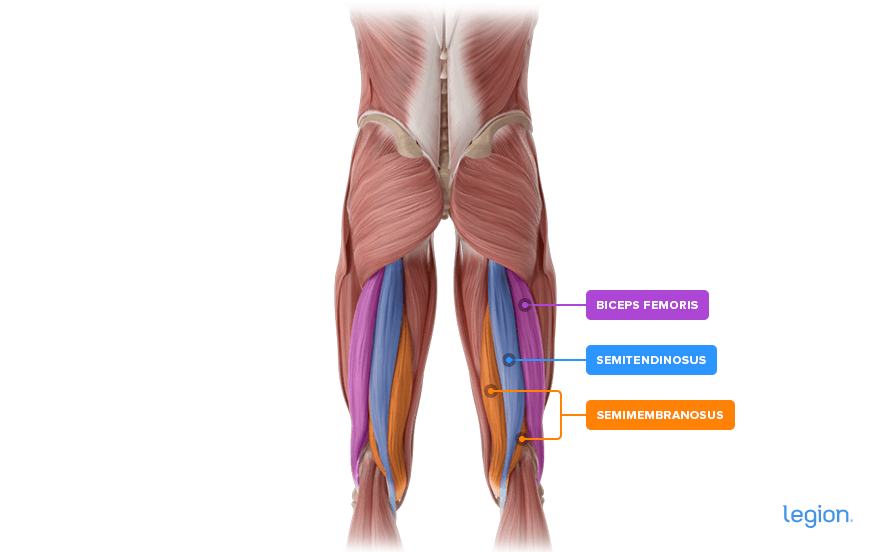
The leg curl primarily trains the hamstrings, though it also trains the glutes and calves to a small degree, too.
Your hamstrings have two primary functions: knee flexion (bending your knee) and hip extension (moving your torso away from your thighs).
One of the main benefits of the leg curl is it trains knee flexion, something most other hamstring exercises (all forms of the deadlift, the hip thrust, and the glute bridge, for example) neglect.
Three of your four hamstring muscles cross both the hip and the knee, but one of them—the short head of the biceps femoris—only crosses the knee. That means it barely participates in hip-hinging exercises like the Romanian deadlift. The only way to fully develop it is with a knee-flexion exercise like the leg curl.
Furthermore, the seated leg curl trains knee flexion while the three largest “parts” of the hamstrings—the long head of the biceps femoris, semitendinosus, and semimembranosus—are fully lengthened. This makes it particularly effective for developing the areas of the hamstrings that have the biggest impact on upper-leg size.
Mixed up the machines? The leg extension is the opposite exercise. You straighten your knees against resistance, which trains your quads, not your hamstrings.
More Hamstring Exercises
- The 5 Best Hamstring Exercises for Stronger, More Defined Legs
- The Best Way to Do the Barbell Romanian Deadlift
- How to Do the Nordic Hamstring Curl: Alternatives, Benefits, and Muscles Worked
- How to Do the Glute Ham Raise for Strong Hamstrings
- The 20 Best Leg Exercises with Dumbbells, Barbells & Machines
The post The Best Way to Do the Leg Curl (Hamstring Curl) appeared first on Legion Athletics.
https://ift.tt/dQhFtYJ August 5, 2026 at 06:00PM Legion Athletics


Comments
Post a Comment