The Best Way to Do the One-Arm Dumbbell Row
- Instructions
- Expert Tips
- Mike's Take
- One-Arm Dumbbell Row Alternatives
- 3 One-Arm Dumbbell Row Workouts
- Muscles Worked by the One-Arm Dumbbell Row
- More Back Exercises
Table of Contents
+Instructions
- Hold a dumbbell in your right hand. Plant your left knee and arm firmly on a bench, your right foot on the floor a foot or two from the bench, and let your right arm (the one holding the dumbbell) hang straight down toward the floor.
- Let the weight pull your shoulder blade as far forward as it can go—it helps to rotate your torso slightly to get an even deeper stretch.
- Keeping your back straight and staring straight ahead, retract your right shoulder blade and pull it as far back as you can, without bending your elbow.
- Once your shoulder blade is as far back as possible, pull the dumbbell to your torso, keeping your elbow close to your sides.
- Once the dumbbell touches your torso, straighten your arm and let the weight pull your shoulder blade forward as far as it’ll go to return to the starting position.
- Once you’ve completed the desired number of reps, repeat the process with your left arm.
Expert Tips
- Think about driving your elbow into the ceiling when doing this exercise, and grip the handle of the dumbbell as hard as you can.
- Take a deep breath of air into your stomach and keep it there throughout each rep (the Valsalva maneuver)—don’t try to breathe throughout each rep the way some trainers teach.
- The most comfortable and stable setup for most people is bracing one knee and hand on a bench and keeping the opposite foot on the floor. If no benches are free, lean on a dumbbell rack or another sturdy surface instead. Keep your torso almost parallel to the floor.
- As you get stronger at the dumbbell row, you’ll probably reach a point where your grip gives out before your back muscles are tired (this is especially true if you’re doing sets of more than ~6 reps). While some purists say you should keep hammering away with the same weight and reps until your grip strength catches up to your back strength, I think a better solution is to use weightlifting straps. This allows you to keep adding weight and reps over time and thus build your back and arm muscles more quickly and efficiently (which is the whole goal of the dumbbell row, after all).
- Sometimes, it makes sense to cheat a little on dumbbell rows. Dumbbell rows have a strange resistance curve, which refers to how hard an exercise feels at different points throughout a rep. They feel easiest when you’re strongest (at the bottom of each rep) and hardest when you’re weakest (at the top of each rep).
- Thus, especially once you’re using very heavy weights, it’s sometimes excusable to use a little momentum to finish your reps. Try to avoid this if you can, though, and use just enough momentum to complete each rep, but no more.
- To help minimize muscle imbalances between your right and left side, I recommend you start every set of dumbbell rows with your weaker side. Then, when you switch hands to train your stronger side, only do as many reps as you got with your weaker side. This prevents your stronger side from getting even stronger and helps your weaker side catch up.
Mike’s Take
The one-arm dumbbell row is one of the single most effective back exercises you can do.
I’ve done it for years and include it in my programs for men and women.
It trains your traps, lats, biceps, rhomboids, rear delts, and a number of other smaller muscles on your back simultaneously. It allows you to use a long range of motion and incrementally add weight, and it’s safe and comfortable for most people.
Training one side at a time also makes it easier to develop a mind-muscle connection with your back and spot and address muscle and strength imbalances (if they exist to any meaningful degree).
Unlike the barbell row, the one-arm dumbbell row depends much less on your lower back strength—when you’re forced to end a set, it’s almost always because your back or biceps reached failure, not because your lower back was fried.
You may be able to lift slightly more total weight this way, too. A review by researchers at the University of Western Ontario found that you can often lift more total weight when using one arm than with two. For example, if you normally do barbell rows with 130 pounds (65 pounds per arm), you might be able to do a single-arm dumbbell row with 75 pounds.
Whether this happens depends on the exercise. I treat any extra load as a bonus, not the main reason to choose the one-arm dumbbell row over the barbell row.
The only real downsides of the dumbbell row are that most strong lifters eventually outgrow the dumbbells available at most gyms, and dumbbells often increase in large jumps, which can make progressive overload more difficult.
And once you get very strong (for instance, pulling close to 100 pounds with each arm), your lower back and supporting arm can begin to fatigue quickly, limiting your progress.
That said, if your gym does have dumbbells that are heavy enough for you, and especially if they increase in small increments (2.5–5 pounds rather than 5–10 pounds), and if your lower back and supporting arm don’t fail before your biceps and back, then this is one of the absolute best exercises you can do.
A good default is 3 sets of 6–8 reps with 2–3 minutes of rest, taking each set 1–2 reps shy of failure.
Quick note: One set of a single-limb exercise entails training both limbs. For instance, you’ve completed one set of 10 reps of the one-arm dumbbell row when you’ve done 10 reps for each arm.
One-Arm Dumbbell Row Alternatives
- Seated Machine Row. My favorite alternative. It has an excellent resistance curve and range of motion and allows you to train your biceps, traps, lats, and rear delts (and completely takes your lower back out of the equation).
- T-Bar Row. Another outstanding alternative, especially if it’s a chest-supported version. If your T-bar row machine doesn’t include chest support, then your lower back may fatigue before your biceps and upper back.
- Seated Cable Row. This is a great alternative, but many people still find their lower back gives out before their traps, lats, and biceps.
- Chest-Supported Dumbbell Row. This is a great alternative that completely takes out the lower back as a limiting factor, but it’s also generally not as comfortable and most people find it limits their range of motion more than the single-arm dumbbell row.
- Barbell Row. This lets you lift more weight and add weight in smaller jumps, but it’s more difficult to learn and perform, and most people’s lower backs fatigue before their arms and upper back, limiting the effectiveness of the exercise.
- Meadows Row. These are similar to one-arm dumbbell rows, and a good alternative if you’ve outgrown your gym’s dumbbells. The main downside is they’re annoying to set up and it can be difficult to grip the barbell, but this can be largely overcome if you use straps.
- Barbell Seal Row. This removes your lower back as a limiting factor and makes it impossible to cheat, but it can also feel awkward. It’s difficult to get good scapular retraction, and few gyms have a proper seal row setup.
- Kroc Row. These are basically single-arm dumbbell rows, but with a reduced range of motion, more momentum, and a slightly flared elbow path. Not a terrible exercise, but they don’t have any meaningful advantages over the regular single-arm dumbbell row.
- Inverted Bodyweight Row. This is a suitable stopgap if you can’t train with dumbbells, barbells, or machines, but it’s impractical to overload and thus isn’t optimal for gaining muscle and strength over time.
- Two-Arm Bent-Over Dumbbell Row. This is basically a barbell row, with dumbbells. It comes with all of the same downsides and is even more awkward to perform. Skip this one.
3 One-Arm Dumbbell Row Workouts
Here are three sample workouts that show how to program the one-arm dumbbell row on a pull day, an upper-body day, or in a dumbbell-only routine.
Pull Day Workout with the One-Arm Dumbbell Row
Barbell Deadlift: 3 sets | 4–6 reps | 2–3 min rest
One-Arm Dumbbell Row: 3 sets | 6–8 reps | 2–3 min rest
Lat Pulldown: 3 sets | 6–8 reps | 2–3 min rest
Barbell Curl: 3 sets | 6–8 reps | 1–2 min rest
Upper-Body Workout with the One-Arm Dumbbell Row
Barbell Bench Press: 3 sets | 4–6 reps | 2–3 min rest
One-Arm Dumbbell Row: 3 sets | 6–8 reps | 2–3 min rest
Seated Dumbbell Shoulder Press: 3 sets | 6–8 reps | 2–3 min rest
Lat Pulldown: 3 sets | 6–8 reps | 2–3 min rest
Dumbbell-Only Pull Workout with the One-Arm Dumbbell Row
Dumbbell Romanian Deadlift: 3 sets | 6–8 reps | 2–3 min rest
One-Arm Dumbbell Row: 3 sets | 6–8 reps | 2–3 min rest
Dumbbell Pullover: 3 sets | 8–10 reps | 1–2 min rest
Hammer Curl: 3 sets | 8–10 reps | 1–2 min rest
To progress these workouts, use double progression: use a weight that allows you to work within the given rep range, take each set 1–2 reps shy of failure, and once you hit the top of the range for your first set, add weight.
Muscles Worked by the One-Arm Dumbbell Row
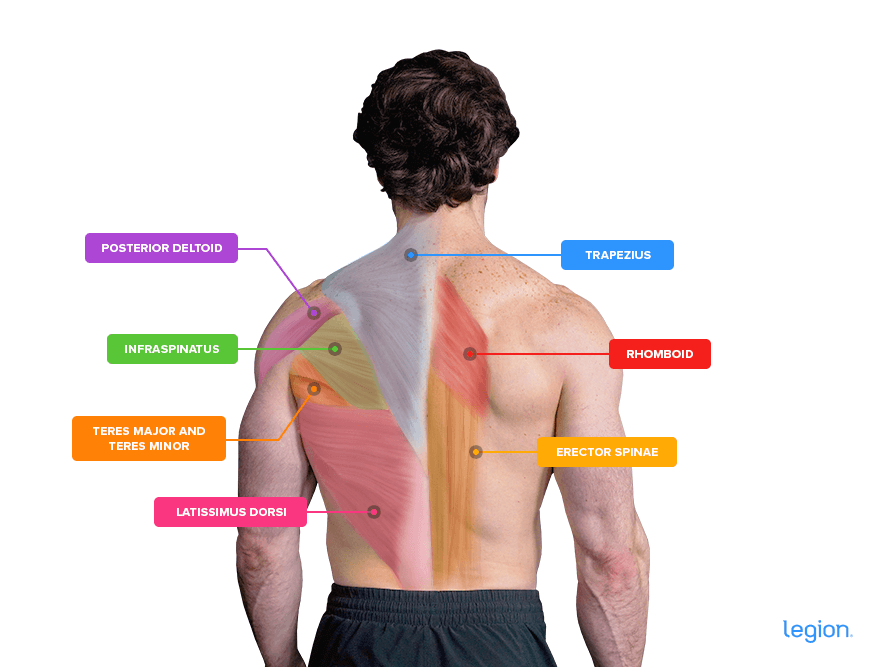
The main back muscles worked by the one-arm dumbbell row are the . . .
- Latissimus dorsi (lats)
- Middle trapezius (mid-traps)
- Rhomboids
- Teres major
Your biceps brachii, brachialis, trapezius, latissimus dorsi, and posterior deltoid (rear delt) are the primary movers, your forearms maintain your grip, and your teres minor, infraspinatus, and spinal erectors help stabilize your shoulder and torso.
Note: If you want to learn more about how to emphasize your traps with this exercise, read this article:
The 15 Best Trap Exercises and Workouts for a Thicker, Stronger Back.
More Back Exercises
- The 12 Best Barbell Row Variations You Can Do
- How to Do the Seated Cable Row: Muscles Worked, Form, and Alternatives
- How to Do Kroc Rows for Upper Back Mass and Strength
- How to Do the T-Bar Row: Alternatives, Form, and Muscles Worked
- The Best Back Workout Routine for Mass & Hypertrophy
The post The Best Way to Do the One-Arm Dumbbell Row appeared first on Legion Athletics.
https://ift.tt/VBGdg9Z August 14, 2026 at 06:00PM Legion Athletics


Comments
Post a Comment