The 5 Best Hip-Dominant Exercises for Glutes and Hamstrings
Here are five of the best hip-dominant exercises you can do:
- Barbell Deadlift
- Barbell Romanian Deadlift
- Barbell Hip Thrust
- Hip Thrust Machine
- Barbell Good Morning
Hip-dominant exercises are lower body strength training exercises where most of the movement occurs at the hips. They contrast with knee-dominant exercises, where most of the movement occurs at the knees. Here’s what the difference looks like:
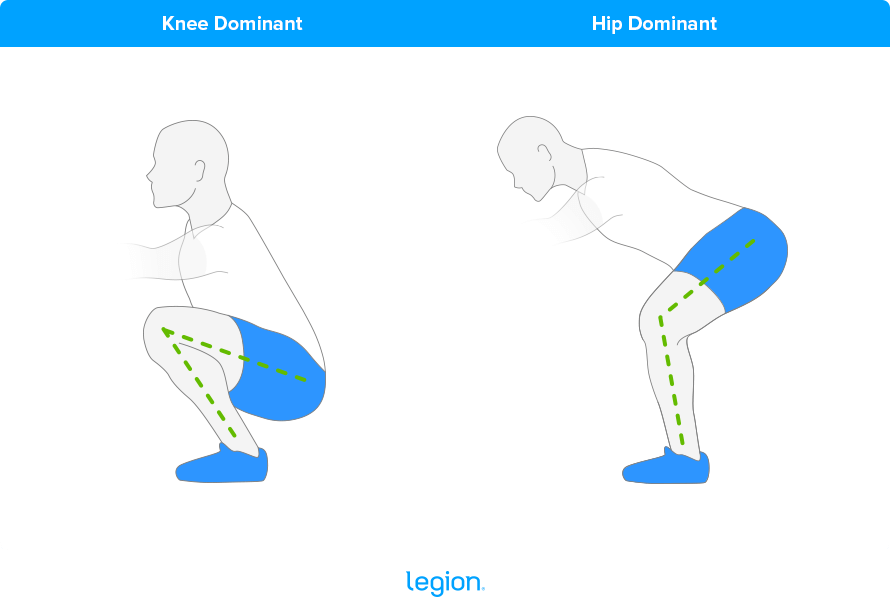
The primary muscles trained during these hip-dominant exercises are the glutes (primarily the gluteus maximus) and hamstrings. Deadlifts, Romanian deadlifts, and good mornings also train your spinal erectors (the muscles along your spine). Deadlifts and Romanian deadlifts work your forearms, too, since you hold the bar in your hands.
Hip-dominant exercises often involve a "hip hinge" motion, which simply refers to bending forward at the waist without rounding your back and with minimal knee bend. The Romanian deadlift is a good example of this movement pattern.
- 1. Barbell Deadlift
- 2. Barbell Romanian Deadlift
- 3. Barbell Hip Thrust
- 4. Hip Thrust Machine
- 5. Barbell Good Morning
- 3 Hip-Dominant Workouts
- What About Squats?
- Want More Workouts Like This?
Table of Contents
+1. Barbell Deadlift
How to:
- Load the bar with plates. If you aren’t strong enough (yet!) to use at least one 45-pound plate on either side, rest the loaded ends on two stacks of plates so the bar sits about 8-to-10 inches off the floor (or use lighter plates with the same diameter as 45-pound plates).
- Position your feet slightly narrower than shoulder-width apart with your toes pointed slightly out, and move the bar over the middle of your feet so that it’s under or slightly behind your shoulders when you bend over and grab it.
- Push your hips backward and bend at the waist and knees until you can touch the bar. Grip it just outside your shins with both palms facing down, and press your upper arms into your sides as if you were trying to crush oranges in your armpits. Keep your arms straight and locked, and your head neutral—don’t look up at the ceiling or down at the ground.
- Take a deep breath into your stomach, brace your abs, squeeze the bar as hard as you can, and straighten your back by pushing your hips slightly upward. The bar shouldn’t rise off the floor yet, but you should feel tension in your lower back, hips, and hamstrings ("taking out the slack").
- Explode upward by pushing through your heels to "break" the bar off the floor, keeping your spine straight, lower back slightly arched, and core tight—your hips and shoulders should rise at the same rate. Once the bar passes your knees, push your hips into it as you continue to stand up. When you’re fully upright, your chest should be out and shoulders down—don’t lean back, hyperextend your lower back, or shrug the weight up.
- To lower the bar, push your hips backward and, keeping your lower back slightly arched and core tight, let the bar slide straight down your thighs until it clears your knees. Then, maintaining your grip, allow it to drop to the floor and adjust your body for the next rep. The entire descent should take one-to-two seconds or less.
Sets, Reps, and Rest: 3 sets | 4–6 reps | 2–3 minutes rest
Why: The conventional barbell deadlift is an excellent exercise for training your glutes, hamstrings, and lower back—all of the main "hip" muscles. The main downside is that many people find their lower back hits failure before their glutes and hamstrings, so it’s often best to pair it with some other exercises for these muscles.
Mike’s tip: Reset after each rep instead of immediately going into the next one. This helps you learn and ingrain better technique.
Alternatives:
2. Barbell Romanian Deadlift
How to:
- Adjust the pins or hooks in a squat rack so the bar is at your midthigh, and load it with plates (or load the bar on the floor if you don’t have a rack).
- Grip the bar just outside your thighs with your palms facing you, lift it off the rack (or floor), take one step back with each foot, and turn your toes out and bend your knees slightly.
- Stand up tall with your chest out and arms at your sides, take a deep breath into your stomach, and brace your abs.
- Squeeze the bar as hard as you can, press your upper arms into your sides, and, with a flat back, lower the bar toward the floor in a straight line, allowing your butt to move backward as the bar descends.
- Once you feel a stretch in your hamstrings, bend your knees just enough to let the bar keep descending, and continue lowering it until your lower back begins to round—just below the knees for most people, about midshin for the particularly flexible.
- Bring the bar upward by driving your hips toward it, keeping your arms straight, lower back slightly arched, and core tight, and return to the starting position.
- On the last rep of a set, finish it fully (legs locked), then move the bar back to the pins or hooks—don’t try to deadlift it directly back onto them.
Sets, Reps, and Rest: 3 sets | 6–8 reps | 2–3 minutes rest
Why: The Romanian deadlift (RDL) trains all of the same muscles as the conventional barbell deadlift, but is generally less taxing and emphasizes the hamstrings and glutes even more.
Mike’s tip: Use weightlifting straps. The main downside of the Romanian deadlift is that your forearms often give out before your hamstrings and glutes, and lifting straps fix that by taking your grip out of the equation.
Alternatives:
3. Barbell Hip Thrust
How to:
- Sit with your upper back resting across a regular bench or against the padded backrest of a dedicated hip thrust bench (as shown in the videos).
- Roll a barbell over your thighs so it sits in your hip crease (use a bar pad or folded yoga mat to protect your hip bones), and plant your feet on the floor or footplate about shoulder-width apart with your toes pointed slightly out. Position your feet so that your shins are vertical and your knees are bent about 90 degrees at the top of each rep.
- Push the bar up with your hips by pressing through your heels until your torso and thighs are parallel to the floor and your shins are vertical.
- Hold this position for about one second, and then reverse the movement and return to the starting position.
Sets, Reps, and Rest: 3 sets | 6–8 reps | 2–3 minutes rest
Why: The hip thrust is one of the most popular and effective exercises for training your glutes, and for good reason. It’s one of the few exercises that effectively isolates your glutes, trains them through a full range of motion, and allows you to add weight in small increments over time.
Mike’s tip: Place a barbell pad or folded yoga mat between the bar and your hip bones to prevent bruising and make the exercise more comfortable.
Alternatives:
- Hip Thrust Machine (below)
- Smith Machine Hip Thrust
- Dumbbell Hip Thrust
4. Hip Thrust Machine
How to:
- Sit with your upper back against the machine’s padded backrest and place your feet on the footplate.
- Position the padded bar across the top of your hips.
- Position your feet about shoulder-width apart with your toes pointed slightly out. Adjust your foot position so your shins are roughly vertical and your knees are bent about 90 degrees at the top of each rep.
- Grip the bar and roll your wrists backward (like revving a motorcycle) and slightly elevate your hips to release the hooks supporting the weight.
- Lower your hips until your butt just barely touches the floor (or as low as you comfortably can without letting your back slip off the pad), then thrust your hips up by pressing through your heels until your torso and thighs form a straight line.
- Hold this position for a brief moment, and then reverse the movement and return to the starting position.
Sets, Reps, and Rest: 3 sets | 6–8 reps | 2–3 minutes rest
Why: The hip thrust machine is my favorite glute exercise. It effectively isolates your glute muscles (primarily your gluteus maximus, the biggest butt muscle), trains them through a full range of motion, allows you to take your sets close or all of the way to failure safely and add weight in small increments over time, and is easier to set up, learn, and perform than the barbell version.
Mike’s tip: Squeeze your glutes as hard as you can at the top of each rep for 1/2 to 1 second. This ensures you’re activating your glutes, using a full range of motion, and moving the weight under control.
Alternatives:
- Barbell Hip Thrust (above)
- Smith Machine Hip Thrust
- Dumbbell Hip Thrust
5. Barbell Good Morning
How to:
- Adjust the hooks in a power rack or squat rack so the bar is at the height of your midchest.
- Duck under the bar and rest it across your upper-back muscles, grip it securely, stand up to unrack it, and take one step back with each foot into a stance about shoulder-width apart.
- Take a deep breath into your stomach, brace your abs, bend your knees slightly, and push your butt backward so your torso hinges forward, lowering the bar toward the floor in a straight line.
- Once you can’t lower the bar any further without rounding your back (usually when your torso is close to parallel with the floor), push your butt forward and lift the bar with your back to return to the starting position.
Sets, Reps, and Rest: 3 sets | 6–8 reps | 2–3 minutes rest
Why: The barbell good morning is essentially the same exercise as the Romanian deadlift, except you hold the bar across your back instead of in your hands. The main advantage of the good morning is that it doesn’t rely on your grip strength, and some people find it more comfortable than the RDL. Personally, I like to rotate between both exercises in my routine, though I typically favor the RDL.
Mike’s tip: Lower the bar only until you feel a stretch in your hamstrings, then stop. Injuries on the good morning are rare, but when they happen, it’s usually from trying to go lower than your anatomy safely allows.
Alternatives:
3 Hip-Dominant Workouts
You don’t need to do all of these exercises to develop your glutes and hamstrings. Instead, pick 1–2 from this list and train them 1–2 times per week, striving to add weight and reps.
You’ll notice that several of the workouts contain almost the same exercises but in a different order. This is by design.
You’ll almost always perform best on your first and second exercises in each workout, so whatever you put first will get the most emphasis. For example, if you want to emphasize your glutes, it’s often best to do hip thrusts first.
Here are three sample workouts that show how to program these exercises for different goals.
Glute-Focused Hip-Dominant Workout
Hip Thrust Machine: 3 sets | 8–10 reps | 2–3 min rest
Barbell Romanian Deadlift: 3 sets | 6–8 reps | 2–3 min rest
Seated Hamstring Curl: 3 sets | 8–10 reps | 1–2 min rest
Hip Abductor Machine: 3 sets | 8–10 reps | 1–2 min rest
Starting with the hip thrust machine allows you to thoroughly train the glutes before you’re fatigued by other exercises. The barbell Romanian deadlift further trains your glutes as well as your hamstrings. The hamstring curl further isolates your hamstrings.
The abductor machine trains the muscles that move your thighs apart, including your gluteus medius and minimus (two smaller glute muscles underneath your gluteus maximus). Not every gym has one of these machines, though, so if your gym doesn’t you can skip it.
Hamstring-Focused Hip-Dominant Workout
Barbell Good Morning: 3 sets | 6–8 reps | 2–3 min rest
Seated Hamstring Curl: 3 sets | 8–10 reps | 1–2 min rest
Lying Hamstring Curl: 2 sets | 8–10 reps | 1–2 min rest
Hip Thrust Machine: 3 sets | 8–10 reps | 2–3 min rest
The first three exercises in this workout are all aimed at thoroughly training your hamstrings. You do good mornings first, as they’re the most technically and physically demanding, followed by two isolation exercises for the hamstrings, and finish with hip thrusts to train your glutes.
Hip-Dominant Leg Workout
Barbell Deadlift: 3 sets | 4–6 reps | 2–3 min rest
Leg Press: 3 sets | 8–10 reps | 2–3 min rest
Hip Thrust Machine: 3 sets | 8–10 reps | 2–3 min rest
Seated Hamstring Curl: 3 sets | 8–10 reps | 1–2 min rest
Hip Abductor Machine: 3 sets | 8–10 reps | 1–2 min rest
This is a well-rounded hip-dominant workout that trains your entire lower body, but with a particular emphasis on your glutes, hamstrings, and abductors. If your gym doesn’t have the hip abductor machine, you can skip it.
What About Squats?
Whether squats are hip- or knee-dominant largely depends on your anatomy and how you perform them.
People with shorter femurs relative to their torso can generally squat more upright, which tends to put more emphasis on their quads. People with longer femurs relative to their torso often need to lean farther forward, which shifts more demand to their hips and lower back. You can’t change these proportions, but your stance, ankle mobility, and heel elevation can change how you squat.
Low-bar squats, where the bar is positioned lower on your back and your feet are generally a bit farther apart, tend to be more hip-dominant (they emphasize your glutes).
High-bar squats, where the bar is positioned higher on your back and your feet are generally a bit closer together, tend to be a bit more knee dominant (they emphasize your quads).
Squats also don’t meaningfully train your hamstrings, whereas most hip-dominant exercises do (except the hip thrust).
All in all, squats can be a great exercise for building your glutes and adductors (inner-thigh muscles). How much they emphasize these muscles depends on your anatomy and how you perform them, and they don’t meaningfully train your hamstrings.
Thus, I typically recommend you think of squats more as a quad exercise that also trains your glutes, rather than a hip-dominant exercise in its own right.
Want More Workouts Like This?
- The 5 Best Hamstring Exercises for Stronger, More Defined Legs
- 6 Knee-Dominant Exercises to Build Bigger, Stronger Quads
- Growing Your Butt: Best Glute-Focused Exercises
The post The 5 Best Hip-Dominant Exercises for Glutes and Hamstrings appeared first on Legion Athletics.
https://ift.tt/k8pKcat October 21, 2026 at 05:00PM Legion Athletics


Comments
Post a Comment