The Best Way to Do the Barbell Back Squat
- Instructions (Low-Bar Squat)
- Instructions (High-Bar Squat)
- Expert Tips
- Workout Programming
- Mike's Take
- High-Bar vs. Low-Bar Squats
- Back Squat Alternatives
- 3 Back Squat Workouts
- Muscles Worked by the Back Squat
- More Leg Exercises
Table of Contents
+Instructions (Low-Bar Squat)
- Adjust the hooks or pins in a squat rack so the bar is at your midchest (about the height of your nipples), and load it with plates (or not, if the bar alone is enough weight). Grip the bar with your palms facing forward, thumbs on top of the bar, and your hands three to six inches wider than shoulder-width apart.
- Holding on to the bar for balance, place your feet underneath it about shoulder-width apart, then duck under the bar and place it across your upper-back muscles, directly across your shoulder blades. Tuck your shoulder blades back and down, and gently adjust the bar until you feel it resting on the "shelf" created by the bony protrusions of your shoulder blades and surrounding back muscles—this is where the bar must remain throughout the exercise.
- Unrack the bar and take one step back with each foot (one at a time). Adjust your feet so they’re shoulder-width apart, toes pointing out at about 20 to 25 degrees. Stand tall with your chest out, take a deep breath into your stomach, and brace your abs.
- Sit straight down by pushing your hips backward and bending your knees at the same time. Keep sitting down until your thighs are parallel to the floor (or as low as you comfortably can).
- Start the ascent by driving through your heels and the middle of your feet, pushing the bar upward in a straight line. Around the halfway mark, push your hips forward and underneath the bar by squeezing your glutes, and return to the starting position.
Instructions (High-Bar Squat)
- Adjust the hooks or pins in a squat rack so the bar is at your midchest (about the height of your nipples), and load it with plates (or not, if the bar alone is enough weight). Grip the bar with your palms facing forward, thumbs wrapped around the bar, and your hands just outside of shoulder-width apart.
- Holding on to the bar for balance, place your feet underneath it about shoulder-width apart (most people like them a little closer together for the high-bar squat), then duck under the bar and place it across your upper-back muscles, directly across the top of your traps. Tuck your shoulder blades back and down, and gently adjust the bar until you feel it resting in the little channel between your upper traps and neck muscles—this is where the bar must remain throughout the exercise.
- Unrack the bar and take one step back with each foot (one at a time). Adjust your feet so they’re shoulder-width apart, toes pointing out at about 20 to 25 degrees. Stand tall with your chest out, take a deep breath into your stomach, and brace your abs.
- Sit straight down by pushing your hips backward and bending your knees at the same time. Keep sitting down until your thighs are parallel to the floor (or as low as you comfortably can).
- Start the ascent by driving through your heels and the middle of your feet, pushing the bar upward in a straight line. Around the halfway mark, push your hips forward and underneath the bar by squeezing your glutes, and return to the starting position.
Expert Tips
- Experiment with placing your feet a little closer together or farther apart and turning your toes a little more in or out. Often, if the back squat feels "off," it’s because you just haven’t found the right foot position yet. Most people find it more comfortable to turn their toes out slightly more and put their feet a little closer together when high-bar squatting, too.
- If your knees have a tendency to cave inward, imagine there’s a crack in the floor running between your feet and think about trying to spread the crack by pushing the floor apart with your feet.
- If you feel like you’re tipping forward or your hips rise faster than your shoulders as you stand up, think about driving your upper back into the bar and slamming it into the ceiling.
- Two cues to help you maintain proper bar position. When low-bar squatting, think about pushing your elbows back and up toward the ceiling. When high-bar squatting, think about squeezing your elbows down into your sides.
- You may need to narrow or widen your grip to find the correct position, where the weight rests almost entirely on your back muscles, not in your hands or on your spine.
- Gaze forward, not down at your toes or up at the ceiling, and try to keep your chest up throughout every part of the rep. Imagine you have a cool design on your T-shirt that you’re trying to show off.
- In terms of depth, most people find the sweet spot is around "parallel," meaning your hip crease is at least level with the top of your knees. If you can’t get quite that low, don’t sweat it—go as low as you comfortably can, and don’t try to force your body to go lower by rounding your lower back.
- If mobility issues prevent you from reaching this depth, squat as low as you comfortably can and work on flexibility exercises for your hips, ankles, and calves.
- On the last rep of a set, finish it fully (legs locked), then move the bar back to the pins or hooks. Don’t try to squat the bar directly back into them—if you miss, you can fall.
- Use the valsalva maneuver and consider using a weightlifting belt (this one is my favorite). Both of these techniques increase intraabdominal pressure, which helps stabilize your torso during heavy squats.
Workout Programming
If your workout includes the back squat, you should almost always do it before any other exercises, when you’re fresh. It’s one of the most technically demanding and exhausting exercises you can do, and you should generally avoid doing it when you’re fatigued.
A good starting point is 3 sets of 4–6 or 6–8 reps, with 2–3 minutes of rest between sets.
Finish each set when you could still do 1–2 more reps with good form. If you’re learning the exercise, use a weight you can control for 8–10 reps before moving to heavier sets.
Mike’s Take
The barbell back squat is one of the best exercises for building stronger quads, adductors, glutes, and spinal erectors, which is why I include it in both of my programs for men and women, Bigger Leaner Stronger and Thinner Leaner Stronger.
It trains all of these muscles simultaneously and allows you to add weight in small increments and continue adding weight over time, which is the best way to gain muscle and strength. Most gyms have a squat rack and barbells, which also means you can do it nearly anywhere.
For most people, it’s a fantastic exercise for building lower body strength and size. Do a few sets of hamstring curls and calf raises, and you’re set.
That said, the squat does have several drawbacks worth noting:
- Not everyone’s anatomy is well-suited to squatting, particularly people with long femurs. These folks will often struggle to fully engage their quads while squatting, relying more on their hips and glutes, and the exercise often feels uncomfortable no matter how much they tinker with their technique. Some people will get better quad growth with leg extensions, leg presses, hack squats, and other exercises (listed below) that allow them to better activate the quads.
- Your spinal erectors and other lower-back muscles can fatigue before your quads and glutes, forcing you to end the set before these muscles are fully trained. This is rarely a problem for beginners, but can become a significant issue once you’ve been training properly for a year or more.
- Squats don’t optimally train every quad muscle. Research shows leg extensions produce more growth in the rectus femoris—the muscle running down the middle of the front of your thigh—than leg presses, and it’s safe to assume this applies to similar exercises like squats and hack squats, too.
In a study conducted by researchers at Ritsumeikan University, 17 untrained adults trained one leg with leg extensions and the other with leg presses twice a week for 12 weeks.
The rectus femoris grew by 13.2% in the leg-extension leg, compared with 1.1% in the leg-press leg. Growth in the other three quad muscles was similar, while the leg press produced more growth in the glutes and adductor magnus, a large inner-thigh muscle.
Again, though, for most people—and especially beginner and intermediate weightlifters—the back squat can be one of the best ways to build lower body size, strength, and mobility.
High-Bar vs. Low-Bar Squats
The high-bar back squat has the barbell resting on the upper trapezius muscles, whereas the low-bar back squat has the barbell resting across your rear deltoids and shoulder blades, about 2 to 3 inches lower (hence the name).
Here’s a side-by-side comparison of the high-bar squat (left) and low-bar squat (right):
Both styles of squatting have pros and cons for different people and goals, but neither is necessarily “better” or “worse” for everyone.
The low-bar squat tends to emphasize your hips and glutes slightly more and allows you to lift a bit more weight, but also puts more stress on your lower-back since you have to lean farther forward. It also requires greater shoulder mobility.
The high-bar squat tends to emphasize your quads a bit more and puts less stress on your lower-back and shoulders, but it also requires more upper-back strength and can feel less stable for some.
In terms of whether you do the low-bar or high-bar squat, I suggest you try both and see which you prefer. Personally, I like to do one variation for 6–8 weeks, then switch to the other for the next 6–8 weeks, and then either switch again or do another variation like the front squat or pendulum squat.
If your goal is to gain muscle, which style you choose should depend mostly on your preferences and anatomy.
In a study conducted by researchers at Nord University and Auckland University of Technology, 12 trained men performed heavy six-rep sets using both bar positions. The researchers found no statistically significant differences in muscle activity between the two styles.
Other research has found similar muscle activity when comparing front and back squats and full (“ass-to-grass”) and parallel squats.
So long as you’re taking your sets relatively close to failure and using proper technique, both squat variations are going to effectively train your quads, glutes, adductors, and spinal erectors.
If you have fairly normal limb lengths and mobility, then it doesn’t matter what style of squatting you do. You can stick entirely to high- or low-bar squatting or do a combination of both—do whatever suits your druthers.
That said, you may prefer the low-bar squat position if . . .
- You have long femurs. In this case, the low-bar squat position will likely make it more comfortable for you to reach parallel (the point at which your thigh is parallel to the floor).
- You want to lift as much weight as possible or compete in powerlifting. In most cases, people can lift about 5 to 10% more in the low-bar position, which makes it a better choice for most powerlifters.
- You have limited ankle mobility, which can make it harder to reach depth while staying upright in a high-bar squat.
- You’re bored with high-bar squatting and want to try something new.
And you may prefer the high-bar squat position if . . .
- Your lower back hurts when low-bar squatting. The low-bar squat requires a more aggressive forward lean, making the high-bar squat more comfortable for some people. You could also try front squatting if it feels comfortable—or, you know, take some time off squatting to let your back heal.
- You have limited shoulder or wrist mobility. This can make it difficult to get your hands in the proper position during the low-bar squat.
- You’re bored with low-bar squatting and want to try something new.
Some people also report that they don’t feel as “tight” or secure while high-bar squatting, but this is mostly just a matter of practice. After a few weeks of high-bar squatting this should no longer be an issue.
And if you’ve tried both high-bar and low-bar squatting and still feel like your quads aren’t growing, you may want to focus on another quad exercise that isn’t limited by your low-back strength, like the leg extension, leg press, or hack squat.
Back Squat Alternatives
- Barbell Front Squat. Holds the bar across the front of your shoulders instead of your upper back. It’s a useful alternative if you prefer that position, though the grip can take practice.
- Leg Press. Lets you train your quads and glutes while seated, without supporting a bar on your back. It’s useful when your back is tired but your legs can handle more work.
- Hack Squat. Supports your back and guides the weight along a fixed path, so you can squat without balancing a barbell.
- Pendulum Squat. This is basically a hack squat that allows your body to move in a more natural range of motion and has a better resistance curve. It’s one of the most comfortable and joint-friendly lower body machines that allows you to safely push as close to failure as you’d like. Sadly, most gyms don’t have one.
- Leg Extension. Isolates your quads without your lower back limiting the set. It also trains the rectus femoris, the muscle running down the middle of the front of your thigh, making it a useful complement to squats.
- Dumbbell Bulgarian Split Squat. Trains one leg at a time with a dumbbell in each hand. It’s handy when you don’t have a barbell, but balance or grip can limit your sets.
- Dumbbell Goblet Squat. Lets you practice squatting with a light dumbbell held at your chest. As you get stronger, holding a heavy dumbbell can become the limiting factor.
3 Back Squat Workouts
Here are three sample workouts that show how to program the back squat in a leg workout, a quad workout, or a full-body workout.
Leg/Lower-Body Workout with the Back Squat
Barbell Back Squat: 3 sets | 4–6 reps | 2–3 min rest
Barbell Romanian Deadlift: 3 sets | 4–6 reps | 2–3 min rest
Leg Extension: 3 sets | 6–8 reps | 1–2 min rest
Lying Leg Curl: 3 sets | 6–8 reps | 1–2 min rest
Leg Press Calf Raise: 3 sets | 8–10 reps | 1–2 min rest
Seated Calf Raise Machine: 3 sets | 8–10 reps | 1–2 min rest
Quad Workout with the Back Squat
Barbell Back Squat: 3 sets | 4–6 reps | 2–3 min rest
Leg Extension: 3 sets | 6–8 reps | 1–2 min rest
Leg Press: 3 sets | 6–8 reps | 2–3 min rest
Leg Press Calf Raise: 3 sets | 8–10 reps | 1–2 min rest
Full-Body Workout with the Back Squat
Barbell Back Squat: 4 sets | 4–6 reps | 2–3 min rest
Barbell Bench Press: 4 sets | 4–6 reps | 2–3 min rest
Seated Machine Row: 3 sets | 6–8 reps | 2–3 min rest
Cable Overhead Triceps Extension: 3 sets | 8–10 reps | 1–2 min rest
EZ-Bar Curl: 4 sets | 8–10 reps | 1–2 min rest
To progress these workouts, use double progression: use a weight that allows you to work within the given rep range, take each set 1–2 reps shy of failure, and once you hit the top of the range for your first set, add weight.
Muscles Worked by the Back Squat
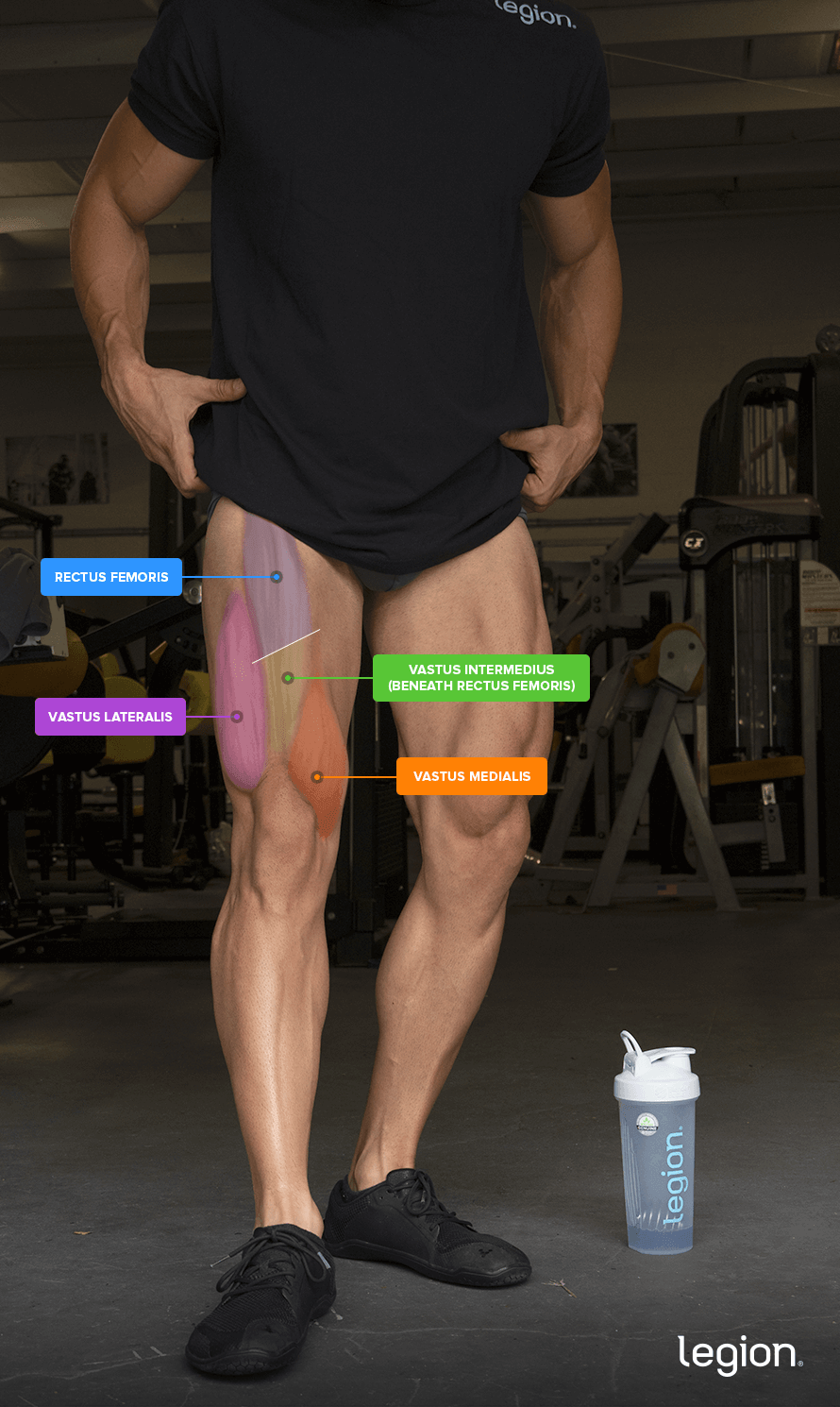
The back squat primarily trains your quads, glutes, adductors (the muscles on the inside of your thighs), and spinal erectors.
Your hamstrings assist slightly, but not enough for squats to be considered a hamstring exercise.
More Leg Exercises
- The Best Way to Do the Dumbbell Bulgarian Split Squat
- The Best Way to Do the Barbell Romanian Deadlift
- The Best Way to Do the Leg Curl (Hamstring Curl)
The post The Best Way to Do the Barbell Back Squat appeared first on Legion Athletics.
https://ift.tt/JvZkLtw October 2, 2026 at 06:00PM Legion Athletics


Comments
Post a Comment