The Best Way to Do the Cable Pullover (Straight-Arm Pulldown)
- Instructions
- Expert Tips
- Workout Programming
- Mike's Take
- Cable Pullover Alternatives
- 3 Cable Pullover Workouts
- Muscles Worked by the Cable Pullover
- More Back Exercises
Table of Contents
+Instructions
- Set the pulley to the highest position on a cable machine and attach a straight bar.
- Grab the bar with your hands a few inches wider than shoulder-width apart and your palms facing away from you. Keep your thumbs on top of the bar rather than wrapped underneath it.
- Step backward until your arms are pulled straight and there’s no more slack in the cable. Lean forward at the waist until your body makes a 45-degree angle with the floor and your arms are nearly straight overhead and in line with your torso.
- Keeping a slight bend in your elbows, pull the bar in an arc toward your feet until the bar runs into your thighs.
- Pause for a brief moment, then reverse the movement and return to the starting position.
Expert Tips
- Allow your torso to straighten slightly at the bottom of each rep and lean over a bit more at the top of each rep. Unlike most isolation exercises, where you want to minimize any movement except for the limbs you’re training, moving your torso slightly back-and-forth helps you get a deeper stretch and more range of motion with this exercise.
- Avoid gripping the bar excessively. I actually like to relax my palms and keep them open, especially at the bottom of each rep, as I find this helps me to feel my lats contracting and avoid relying on my triceps. Think about pulling your elbows down and into your sides, rather than pushing the bar downward.
- Squeeze your lats hard at the bottom of each rep, and hold that position for 1/2 to 1 second. This helps ensure you’re activating your lats, using a full range of motion, and moving the weight under control.
- Avoid straightening and bending your arms throughout each rep. It’s fine to have some bend in your elbows, but it should be consistent from rep-to-rep and set to set.
- Allow the weight to return to the starting position under control—don’t relax your lats and let the handle fly upward.
- You’ll sometimes see people do this exercise with a rope handle, but I prefer a straight metal bar, lat pulldown bar, or even an EZ-bar (if nothing else is available). Having a rigid handle allows you to focus more on contracting your lats rather than stabilizing the handle.
- It’s normal to feel your triceps working during this exercise, especially at the bottom of each rep. As I noted above, one way to avoid over-relying on your triceps is to keep your palms relaxed and open.
Workout Programming
It’s best to program the cable pullover as part of a back, pull, or upper-body workout, after your rows, pulldowns, or other compound exercises.
A good default is 2–3 sets of 8–10 reps. Take each set 1–2 reps shy of failure and rest 1–2 minutes between sets.
Mike’s Take
The cable pullover, sometimes called the “straight-arm lat pulldown” or “lat prayer,” is one of the few exercises that allows you to truly isolate your lats, and I’ve been using it for almost two decades.
It trains your lats through a full range of motion, is safe and easy to learn, you can do it in any gym that has a cable station, and it allows you to take your lats close or all of the way to failure without your biceps giving out first.
Most lat exercises, like the lat pulldown, close-grip pulldown, pull-up, and so on, also heavily rely on your biceps, which typically fatigue faster than your lats.
Thus, what usually happens is you’re forced to end your sets before your lats are fully trained. Part of this can be overcome by using proper technique, but it’s also just an inherent limitation of these compound pulling exercises.
Since the cable pullover doesn’t involve bending your arms (elbow flexion), it completely removes your biceps as a limiting factor. This gives you greater control over which muscles you emphasize.
For example, you could do cable pullovers first in your workout, followed by biceps exercises like the Bayesian cable curl, incline dumbbell curl, or curl machine. This would allow you to train your lats and biceps separately, ensuring that one muscle doesn’t limit the other and that you can take each muscle group close or all of the way to failure.
Or, you could do cable pullovers after your pull-ups to continue training your lats after your biceps are fatigued.
The main downsides of the cable pullover are as follows:
- It doesn’t train as many muscle groups as exercises like the lat pulldown, pull-up, and underhand machine lat pulldown. But, this is always the tradeoff with isolation exercises: greater control over which muscles are trained, but you don’t train as many muscles at once.
- Some cable machines force you to add weight in large jumps (such as 10–20 pounds), which makes progressive overload impractical.
- As you get stronger, your triceps have to work harder and harder to keep your arms straight, especially at the bottom of each rep. And in some cases, this can actually limit how much weight you can use. You can partly overcome this by shortening the range of motion slightly, so that you don’t push the bar all of the way down to your thighs. Personally, I’ve always found that my lats still hit failure before my triceps, but it could be an issue for you depending on your anatomy.
- It can become hard to control the weight as you get stronger, especially once you’re using about 30–50% of your body weight. At this point, it’s often ideal if you can use a pullover machine instead, but many gyms don’t have one.
That said, the pros far outweigh the cons, which is why this is one of my favorite lat exercises.
Generally speaking, I’ve found that the cable pullover is best-suited for intermediate to advanced weightlifters. Not because the exercise is technically difficult (it’s very easy to learn), but because beginners generally don’t need to worry about isolating their lat muscles—simply getting strong on lat pulldowns, pull-ups, and rows is enough to make their lats grow.
But, there’s also no harm in giving it a try even as a beginner.
Cable Pullover Alternatives
- Machine Pullover. This trains all of the same muscles, but is more stable and thus allows you to better control the weights and target the lats, especially with heavy weights. Sadly, few gyms have one.
- Dumbbell Pullover. This trains the same basic movement pattern as the cable pullover, but it’s more awkward to set up and perform and has a worse resistance curve than the cable version (meaning the weight is significantly more or less challenging at different points throughout each rep).
- Lat Pulldown. Trains your lats, biceps, and traps together, making it a more time-efficient choice when you want to train more of your back and arms at once.
- Underhand Machine Lat Pulldown. Trains your lats, biceps, and traps, with the machine providing extra stability. It doesn’t isolate your lats like the cable pullover, but it’s easier to control with heavy weights.
3 Cable Pullover Workouts
Here are three sample workouts that show how to program the cable pullover.
Back Workout with the Cable Pullover
Chest-Supported Seated Machine Row: 3 sets | 6–8 reps | 2–3 min rest
Close-Grip Lat Pulldown: 3 sets | 6–8 reps | 2–3 min rest
Cable Pullover: 2 sets | 8–10 reps | 1–2 min rest
Machine Rear Delt Fly: 3 sets | 8–10 reps | 1–2 min rest
Pull Workout with the Cable Pullover
Barbell Deadlift: 3 sets | 4–6 reps | 2–3 min rest
Chest-Supported Seated Machine Row: 3 sets | 6–8 reps | 2–3 min rest
Lat Pulldown: 3 sets | 6–8 reps | 2–3 min rest
Cable Pullover: 2 sets | 8–10 reps | 1–2 min rest
Bayesian Cable Curl: 3 sets | 8–10 reps | 2–3 min rest
Upper-Body Workout with the Cable Pullover
Barbell Bench Press: 3 sets | 4–6 reps | 2–3 min rest
Chest-Supported Seated Machine Row: 3 sets | 6–8 reps | 2–3 min rest
Incline Dumbbell Bench Press: 3 sets | 8–10 reps | 2–3 min rest
Cable Pullover: 2 sets | 8–10 reps | 1–2 min rest
Cable Lateral Raise: 3 sets | 8–10 reps | 1–2 min rest
To progress these workouts, use double progression: use a weight that allows you to work within the given rep range, take each set 1–2 reps shy of failure, and once you hit the top of the range for your first set, add weight.
Muscles Worked by the Cable Pullover
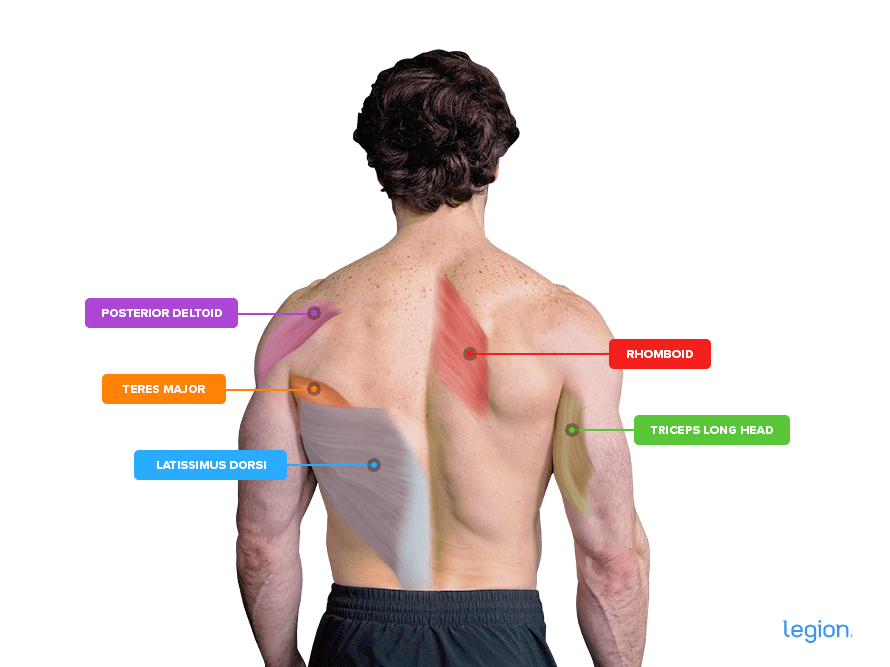
The cable pullover primarily trains your lats (latissimus dorsi) and teres major (a small muscle near your armpit), which pull your upper arms down from overhead toward your sides (shoulder extension).
Your rear delts and the long head of your triceps help pull your upper arms down. Your mid-back muscles, including your rhomboids, stabilize your shoulder blades, while your rotator cuff stabilizes your shoulder joints. Your triceps also keep your arms straight, and your abs and glutes keep your torso stable.
More Back Exercises
- The 13 Best Lat Exercises and 3 Lat Workouts
- The Best Way to Do the Lat Pulldown
- The Best Way to Do the Seated Machine Row
- 4 Pull Day Workouts & 15 Exercises for Your Back & Biceps
The post The Best Way to Do the Cable Pullover (Straight-Arm Pulldown) appeared first on Legion Athletics.
https://ift.tt/x17VD6m October 26, 2026 at 06:00PM Legion Athletics


Comments
Post a Comment