The Best Way to Do a Pull-Up for a Stronger, More Defined Back
- Instructions
- Expert Tips
- Workout Programming
- Mike's Take
- Pull-Up Alternatives
- 3 Pull-Up Workouts
- Muscles Worked by the Pull-Up
- More Back Exercises
Table of Contents
+Instructions
- Grab a pull-up bar with your palms facing away from you and your hands about shoulder-width apart. If you can’t reach the bar without jumping, put something on the floor under the bar that you can step on.
- Lift your feet off the floor and relax your arms and shoulders, letting your body weight pull your arms straight and your shoulders as high as possible (they should be almost touching your ears).
- Keeping your arms straight, pull your shoulder blades down and back to raise your chest and lean back slightly.
- Pull your chest toward the bar and your elbows toward your sides, bringing your feet slightly forward as you rise. Pull until your chin clears the bar, or touch your chest to the bar if you can do so comfortably.
- Pause for a brief moment, and then lower yourself to the starting position.
Expert Tips
- One technique that will immediately make you stronger at pullups is to lean back slightly so your chest is facing the bar. Your arms and torso should be in almost the same position as they would be in an incline bench press. This puts your lats in a much more biomechanically efficient position for pulling, and better engages your lats.
- As you pull yourself up, flex your abs and allow your feet to drift forward naturally. Keep the movement controlled—don’t kick or swing your legs to launch yourself toward the bar.
- A good cue to remember is “tighter is lighter.” Instead of relaxing your body, flex your glutes and core. I like to cross my feet to help with this, too. If you’re using a weighted dip belt, it’s also helpful to wrap your legs around the weight plate to keep it from swinging.
- Ideally, try to touch your chest to the bar at the top of each rep. This is easier for some than others based on their anatomy, so if this isn’t possible for you, try to at least pull yourself high enough that the bar is somewhere between your collarbone and chin.
- Try to pull yourself to the same height for every rep, even as the set gets hard.
- You can use either a “full grip,” with your thumb wrapped around the bar opposite from your fingers, or a “false grip,” with your thumb resting next to your index finger on the bar. The full grip tends to be more secure, although some people find it uncomfortable, so choose whichever one you prefer.
- Many people like to make pull-ups easier by stopping the descent before their arms are completely straight. This reduces the range of motion and makes the exercise easier, but also less effective, especially for training your traps. Instead, lower your body completely to a “dead hang” before starting your next rep.
Workout Programming
Use the pull-up in a back, pull, or upper-body workout. In a pull workout, I generally recommend doing your hip-hinge exercises and horizontal rows first—for example, deadlifts and a chest-supported machine row.
Do 3 sets of 6–8 reps, resting 2–3 minutes between sets and finishing each set with 1–2 reps left. Once you can do 8 full reps with your body weight, add weight using a dip belt or by pinching a dumbbell between your thighs.
Mike’s Take
The pull-up is one of the best exercises you can do for your back and arms. It simultaneously trains your lats, biceps, lower traps, and rear delts through a full range of motion, and even your forearms. Some research also shows reasonably high ab activation during pull-ups, though I’d think of that more as a bonus rather than treating the pull-up as an ab exercise.
It’s also one of the few bodyweight exercises that is still worth doing once your newbie gains are behind you. This is because it’s challenging even with just your body weight and because it’s easy to add weight as you get stronger by using a dip belt or pinching a dumbbell between your thighs.
Once you’re strong enough to add weight to the pull-up, I highly recommend you invest in a dip belt. I like this one from Rogue.
The main downside of the pull-up is that it takes more coordination than other vertical pulling exercises, like the lat pulldown, underhand machine lat pulldown, or cable pullover, which can make it harder to isolate your lats. Many people also find that their grip strength and biceps fail before their lats, which can force you to end your sets before your lats are fully trained.
This is partly due to technique, but can also be due to anatomy, which is why some people find that their lats grow better with exercises like the lat pulldown, close-grip lat pulldown, and underhand machine lat pulldown.
One of the most common questions about the pull-up is how to work up to your first one. Instead of an elaborate progression of dead hangs, negatives, and banded pull-ups, I prefer a simpler approach: Get really strong on lat pulldowns, and lose excess body fat.
Once you can do lat pulldowns with good technique with about 10% more than your body weight, you’ll almost certainly be able to do at least one pull-up. For instance, if you weigh 180 pounds and can do 6–8 reps with 200 pounds, you should be able to do a pull-up with good form.
In addition to simply strengthening your back and arms with pulldowns, losing body fat makes a massive difference in your ability to do pull-ups. If you’re carrying an extra 10, 20, or 30 pounds of excess fat, you’re essentially already doing weighted pull-ups. Lose the fat, and an exercise that seemed impossible before becomes very doable.
Another common question people have is whether they should do pull-ups or chin-ups. The answer is that both are equally good for building your arms and back, and which you choose mostly boils down to your anatomy and personal preference.
Both train almost all of the same muscles at nearly the same angles and through almost the same range of motion, so you can think of them as interchangeable in your workouts.
Research shows that pull-ups and chin-ups produce about the same amount of lat muscle activity, while chin-ups may involve the biceps slightly more and pull-ups may involve the lower traps slightly more. That said, this study only looked at muscle activation, not muscle growth, and in my experience there’s no meaningful difference in muscle growth between the two exercises.
My usual advice is to do whichever exercise is more comfortable for you. Some people find that pull-ups are more comfortable on their shoulders and elbows than chin-ups, whereas others feel the opposite, so you should try both and see which plays better with your joints.
If you don’t have a strong preference, focus on one for 6–8 weeks, then switch to the other for 6–8 weeks, and repeat ad infinitum or until you want to try a different vertical pulling exercise like the close-grip lat pulldown.
Pull-Up Alternatives
- Chin-Up. Almost identical to the pull-up, but it may emphasize your biceps slightly more. You can use these exercises interchangeably.
- Neutral-Grip Pull-Up. Your palms face each other instead of away from you. Some people find this grip more comfortable.
- Lat Pulldown. This trains all of the same muscles, but requires less coordination, which typically makes it easier to isolate your lats.
- Close-Grip (V-Grip) Lat Pulldown. Almost identical to the lat pulldown, but with your hands facing each other instead of facing away from you.
- Underhand Machine Lat Pulldown. One of my favorite vertical pulling exercises. It trains all of the same muscles, but requires less coordination than pull-ups and better isolates your lats.
3 Pull-Up Workouts
Here are three sample workouts that show you how to program the pull-up.
Back Workout with the Pull-Up
Chest-Supported Machine Row: 3 sets | 6–8 reps | 2–3 min rest
Pull-Up: 3 sets | 6–8 reps | 2–3 min rest
Cable Pullover: 3 sets | 6–8 reps | 2–3 min rest
Machine Rear Delt Fly: 3 sets | 8–10 reps | 1–2 min rest
Pull Day Workout with the Pull-Up
Barbell Deadlift: 3 sets | 4–6 reps | 2–3 min rest
Chest-Supported Machine Row: 3 sets | 6–8 reps | 2–3 min rest
Pull-Up: 3 sets | 6–8 reps | 2–3 min rest
EZ-Bar Curl: 3 sets | 8–10 reps | 1–2 min rest
Upper-Body Workout with the Pull-Up
Barbell Bench Press: 3 sets | 4–6 reps | 2–3 min rest
Chest-Supported Machine Row: 3 sets | 6–8 reps | 2–3 min rest
Incline Dumbbell Bench Press: 3 sets | 6–8 reps | 2–3 min rest
Pull-Up: 3 sets | 6–8 reps | 2–3 min rest
To progress these workouts, use double progression: use a weight that allows you to work within the given rep range, take each set 1–2 reps shy of failure, and once you hit the top of the range for your first set, add weight.
Muscles Worked by the Pull-Up
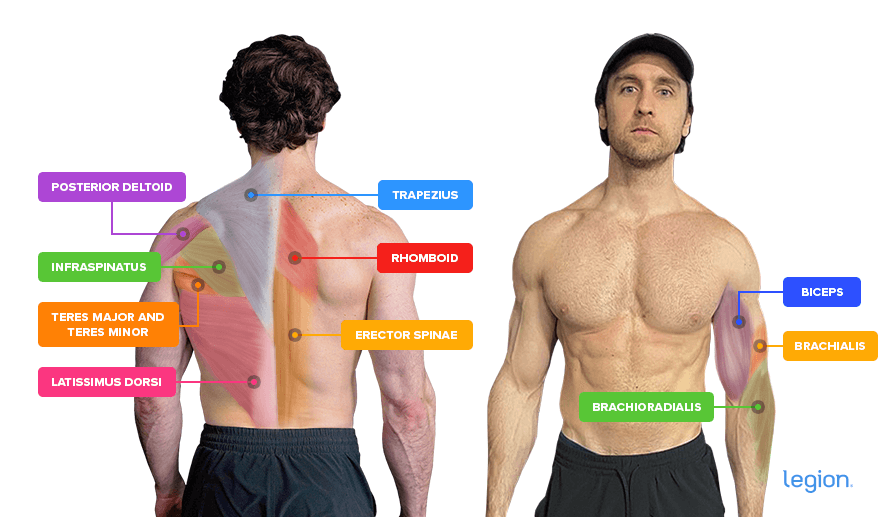
The pull-up primarily trains your latissimus dorsi (lats), biceps, brachialis, brachioradialis, lower traps, and rear delts.
Your lats pull your upper arms toward your torso, while your biceps, brachialis, and brachioradialis bend your elbows. Your lower traps help pull your shoulder blades down, and your rear delts help pull your upper arms backward. Your forearm muscles keep a firm grip on the bar.
More Back Exercises
- The 13 Best Lat Exercises and 3 Lat Workouts
- The Best Way to Do the One-Arm Dumbbell Row
- The Best Way to Do the Close-Grip (V-Grip) Lat Pulldown
The post The Best Way to Do a Pull-Up for a Stronger, More Defined Back appeared first on Legion Athletics.
https://ift.tt/UuvndgJ October 16, 2026 at 03:00PM Legion Athletics


Comments
Post a Comment